- A b2b sales and marketing funnel is a revenue system, not a list of tactics.
- Design for modern buying: dark funnel research, AI discovery, and “prove it” validation before demos.
- Use 7 b2b funnel stages: Demand Creation, Demand Capture, Qualification, Validation, Business Case, Close, then Onboarding and Expansion.
- Align sales and marketing with shared definitions, SLAs, routing, and fit + intent lead scoring.
- Build a validation layer (proof assets, security answers, clear implementation plan) to reduce risk and speed decisions.
- Measure a KPI spine: stage to stage conversion, speed to lead, pipeline velocity, win rate, time to contract, and post sale activation and retention.
- For SEO and AEO, publish citable, structured content and keep your best proof and methodology ungated.
- Fast 30 day wins: fix the handoff, upgrade one high intent page, and ship one high impact proof asset.
You can have great ads, a gorgeous website built with Webflow Development, and a sales team that can “handle objections” in their sleep, and still miss revenue.
Why? Because a b2b sales and marketing funnel is not a list of tactics. It’s the operating system that decides whether attention turns into pipeline, and pipeline turns into closed won.
Today, the buyer journey got a few upgrades that most funnel guides still ignore:
- Buyers do heavy research in the dark funnel, meaning they learn a lot about you before you ever see a form fill.
- AI assistants and LLM answers are now part of discovery. Prospects show up already opinionated because an AI summary handed them a shortlist.
- “Just book a demo” is not a strategy. Buyers want proof, clarity, and a low friction path to validate.
So let’s build this the way marketing directors and brand leaders actually need it: a funnel that aligns sales and marketing, makes measurement sane again, and creates revenue you can forecast without crossing your fingers.
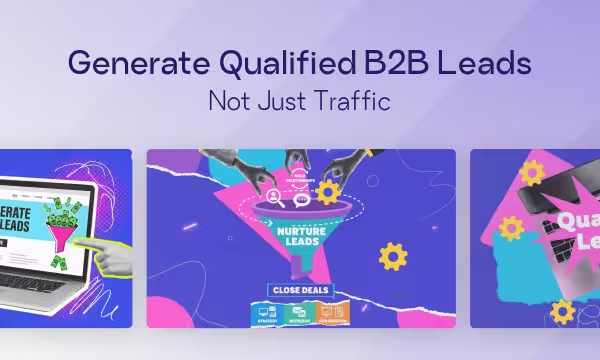
If your biggest bottleneck is turning website traffic into real opportunities, read How To Generate & Capture More Qualified B2B Leads On Your Website.
What Is A B2B Sales And Marketing Funnel?
A B2B sales and marketing funnel is the end to end system that attracts the right accounts, converts interest into qualified conversations, and helps multiple stakeholders reach a confident buying decision.
If you want the simplest definition that still holds up in the real world, it’s this:
Marketing earns attention and intent. Sales turns intent into decisions. RevOps makes sure both teams are looking at the same scoreboard.
This is also where a lot of teams get tripped up. They treat the funnel like a one time campaign map. But a sales funnel in B2B behaves more like a loop:
- You will re-engage stalled deals.
- You will recycle leads that were not ready.
- You will expand accounts after onboarding.
If your funnel doesn’t include those loops, you are basically budgeting to lose.

Why Does A B2B Funnel Feel Harder Than A B2C Funnel?
Because B2B buying is a group project with deadlines, politics, and spreadsheets.
Most B2C funnels focus on a single buyer and a fast decision. A B2B marketing sales funnel is different because:
- Sales cycles are longer.
- The decision is rational and ROI driven, but still emotional when careers are on the line.
- Personas change throughout the journey. The end user might discover you, but finance and security can veto you.
That’s why the best b2b funnel stages don’t just “nurture leads.” They help buyers build internal consensus.
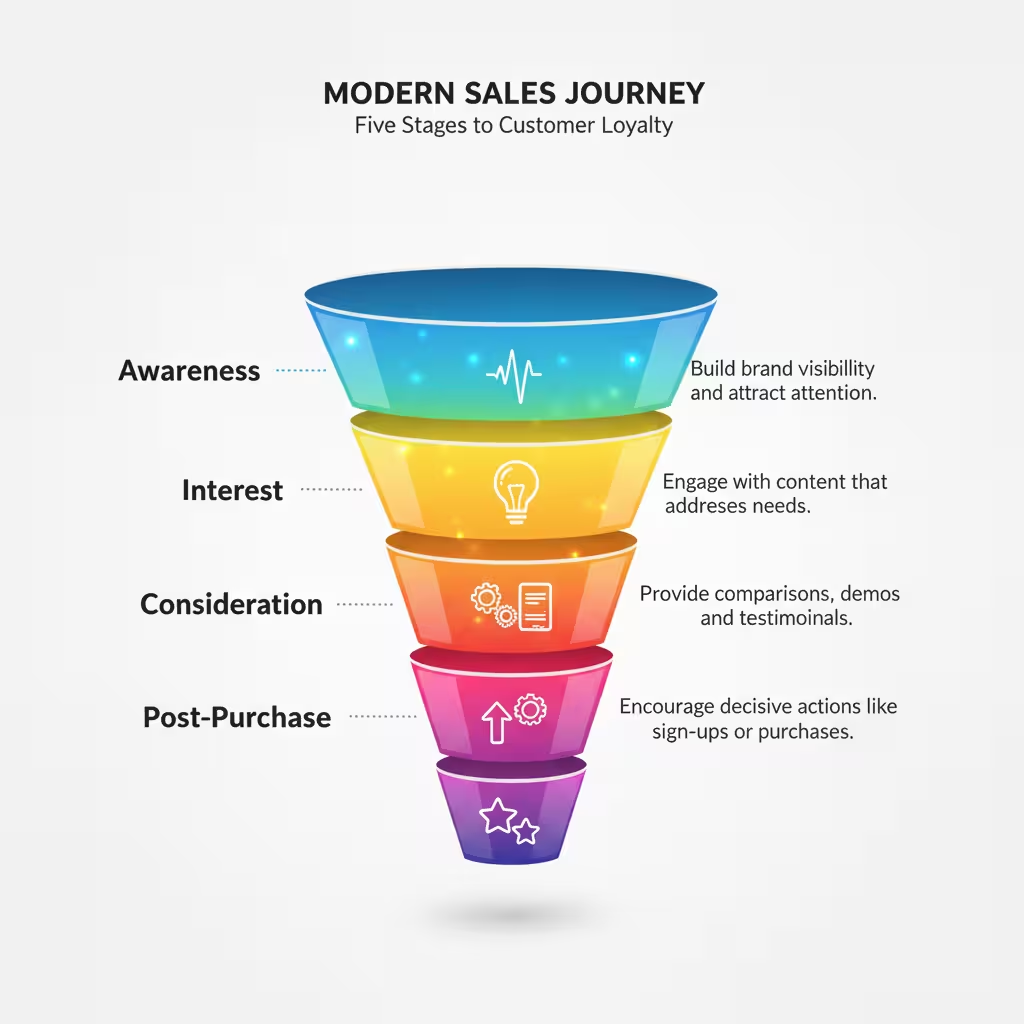
What Are The Stages Of A High Performing B2B Sales And Marketing Funnel?
Most teams can name the classic three. The teams that consistently hit revenue targets add the missing middle and the post sale layer.
Here’s the full system we use when we build a b2b lead generation funnel that’s meant to scale.
Stage 1: Demand Creation (Unaware To Problem Aware)
Goal: get on the shortlist early by naming the problem better than anyone else.
This stage is where most SEO is won and lost, because you are competing for the early questions.
What works:
- Pain point education and benchmarks
- Practical playbooks and checklists
- Category and glossary pages that answer “what is” and “how does it work” clearly
AEO note: this is also where you want content that an LLM can quote without gymnastics. Clear definitions, clear steps, and clean structure.
Stage 1 metrics to track: ICP traffic share, non-branded to branded lift, engaged sessions (scroll depth and repeat visits), and new known leads or new engaged accounts.
Stage 2: Demand Capture (Solution Aware To Approach Selection)
Goal: move from “interesting” to “this is a serious option.”
This is the home of:
- Use case pages by industry and job to be done
- Comparison and alternatives pages
- “How to choose” guides that don’t read like vendor propaganda
If you sell B2B SaaS, this is where a b2b saas marketing funnel lives or dies.
Stage 2 metrics to track: visit to lead conversion rate on use case pages, high intent content conversion (templates, calculators, webinars), return rate from target accounts, and CTR on commercial intent SERPs.
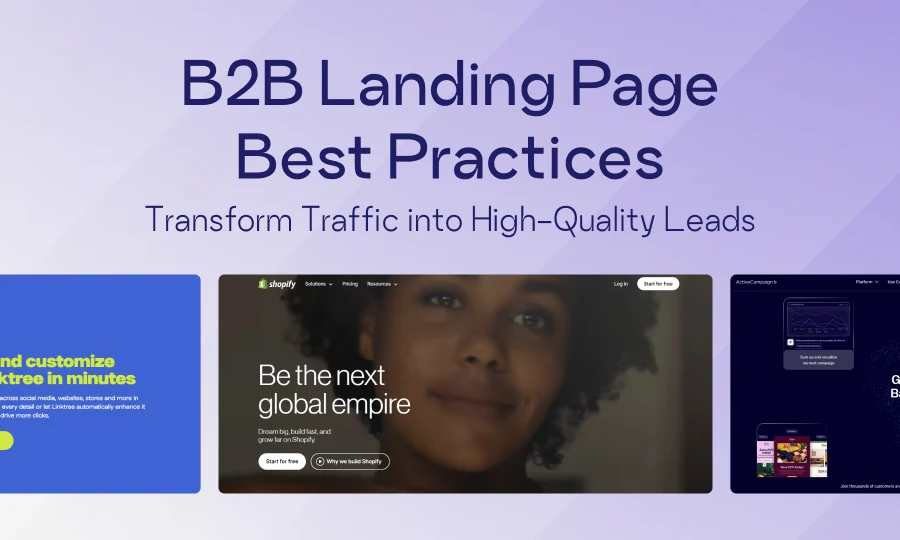
To tighten this stage even more, use our checklist: B2B Landing Page Best Practices to Turn Traffic into Qualified Leads.
Stage 3: Qualification (Fit + Intent)
Goal: decide what happens next, fast.
This is where many funnels break because “MQL” is treated like a trophy instead of a decision.
A strong qualification layer combines:
- Fit signals: who they are
- Intent signals: what they did and why now
If your marketing funnel b2b is producing leads that sales won’t touch, it’s not a lead problem. It’s a definition problem.
Stage 3 metrics to track: MQL rate, MQL to SQL acceptance rate, speed to lead (median minutes), and recycle rate with reason codes.
Stage 4: Validation (Proof, Not Pitch)
Goal: reduce perceived risk.
Buyers do not want more claims. They want evidence that they can use internally.
Examples:
- Case studies by segment and outcome
- Security, IT, and procurement packs
- A self guided product tour or sandbox
- A clear implementation plan for weeks 1 to 4
This is the single most under built part of the typical sales funnel for B2B.
Stage 4 metrics to track: meeting show rate, second meeting rate, sales content usage (what assets correlate with wins), tour or trial completion rate, and stakeholder coverage per opportunity.
Stage 5: Consensus And Business Case (Pipeline Acceleration)
Goal: help the champion sell it internally.
If you’ve ever lost a deal to “we’re not sure,” this stage was missing.
Assets that speed up decisions:
- ROI model with assumptions
- Stakeholder one pagers for CFO, IT, Operations, Marketing
- Mutual action plan that makes next steps obvious
Stage 5 metrics to track: time in stage, mutual action plan adoption rate, procurement and security cycle time, and a simple champion health score (standardized criteria).
Stage 6: Decision And Close (Conversion)
Goal: remove friction.
Here’s what “friction” looks like in B2B:
- unclear pricing logic
- slow contracting
- missing trust signals
- internal confusion over who owns next steps
Your b2b conversion funnel should be designed so that “yes” feels safe, and “no” has a clear reason code you can learn from.
Stage 6 metrics to track: win rate, sales cycle length, time to contract, discount rate, and closed lost reasons (trended monthly).
Stage 7: Onboarding, Adoption, And Expansion (Revenue Compounding)
Goal: turn customers into renewals, referrals, and expansions.
Teams that stop measuring at closed won are basically turning off the lights right before the after party.
Stage 7 should include:
- onboarding milestones and activation metrics
- enablement content and training
- QBRs and expansion triggers
Stage 7 metrics to track: activation rate by day 7/14/30, time to first value, gross and net retention, and expansion pipeline.
How Do You Map Content And Channels To Each B2B Funnel Stage?
The fastest way to make a funnel messy is to run channels without stage intent.
Use this simple mapping to keep your plan clean:
- SEO and AEO: stages 1 to 3, plus comparisons for stage 2 to 4
- LinkedIn organic and paid: stages 1 to 5
- Paid search: stages 2 to 4
- Email nurture: stages 2 to 5 and re engagement
- Webinars and events: stages 2 to 5
- Product tours and sandboxes: stages 4 to 6
- Customer marketing: stage 7 and advocacy
The secret is not “do more channels.” It’s “make every channel earn its keep.”
What Makes A B2B Sales And Marketing Funnel Actually Convert?
Conversion comes from three things working together:
- Clear Stage Entry And Exit Criteria
If you cannot answer “what does it mean to be in this stage,” your reporting will be fictional.
Define:
- what action moves a buyer forward
- what disqualifies or recycles them
- who owns the next step
- Low Friction Validation
In 2026, buyers expect to validate before they talk.
That can look like:
- interactive product tours
- sandbox environments
- transparent implementation steps
- clear security answers
This is not about removing sales. It’s about making sales conversations higher quality.
- Consistent Follow Up And Re Engagement
Most B2B revenue is not lost because “they hated you.” It’s lost because:
- timing changed
- priorities shifted
- the champion got busy
- the internal approval chain got messy
Your funnel must include re engagement sequences based on stall reasons.
How Do You Align Sales And Marketing Teams Within A B2B Funnel?
Alignment is not a workshop. It’s an agreement with consequences.
Here’s the practical model:
Agree On Lifecycle Definitions
Write down definitions in your CRM, not in a Google Doc that nobody opens:
- Lead
- MQL
- SQL
- Opportunity
Set SLAs That Protect Speed To Lead
For high intent inbound, speed matters.
A simple SLA system:
- sales follows up on hot inbound within 5 to 15 minutes during business hours
- marketing ensures source and campaign tagging is accurate
- sales dispositions every lead: accept, recycle, reject with a reason
Build Routing Rules That Match Your Motion
Different motions need different routes:
- enterprise ABM
- mid market inbound
- partner
- product led
Routing is where alignment becomes real.
What Should Your Lead Scoring Model Include In A B2B Funnel?
Lead scoring should answer one question: is this worth a human conversation right now?
The cleanest model is a two score system:
Fit Score (Who)
- firmographics: size, industry, region
- technographics: tech stack and integrations
- constraints: compliance and security needs
Intent Score (Why Now)
Intent is not “they read a blog.” Intent is behavior tied to decisions.
High intent signals typically include:
- pricing page and demo page engagement
- integration documentation views
- comparison page engagement
- returning visits from the same account
The scoring thresholds should route to the right next step, not just create more SDR work.
How Do You Measure A B2B Sales And Marketing Funnel Without Getting Lost In Dashboards?
If you track everything, you will learn nothing.
Use a KPI spine: a small set of metrics that show stage health.
At a minimum, track:
- ICP traffic share (not just total traffic)
- conversion rates between stages
- MQL to SQL rate
- SQL to opportunity rate
- win rate
- sales cycle length
- pipeline velocity
- CAC payback and expansion
And because dark funnel is real, add two practical measurement methods:
- self reported attribution (“How did you hear about us?”)
- enablement usage (what content is used in sales cycles that convert)
If you want a shortcut, build one dashboard that answers four questions:
- Are we attracting the right accounts?
- Are we converting them into qualified conversations?
- Are deals moving or stalling?
- Are customers sticking and expanding?
If a metric doesn’t help answer one of those, it’s probably dashboard glitter.
How Do You Build A B2B Funnel That Works For SEO And AEO At The Same Time?
This is the part most funnel content skips, which is wild because discovery is changing fast.
Here’s the play:
Create “Citable” Pages, Not Just Blog Posts
LLMs love content that is structured, specific, consistent, and easy to quote.
Build pages that clearly explain:
- definitions
- frameworks
- decision criteria
- step by step implementation
Use Semantic Coverage Without Keyword Stuffing
You want Google to understand topical authority, and you want AI answers to see you as a reliable source.
That means naturally using phrases like:
- sales funnel b2b
- marketing funnel b2b
- b2b sales funnel stages
- b2b funnel stages
- b2b sales funnel examples
But only when they actually fit the sentence.
Publish Methodology And Proof In Public
If your best thinking is locked behind a form, you are asking both Google and AI answers to ignore it.
Keep the good stuff accessible:
- your process
- your assumptions
- your proof
- your examples
That is how you win citations and trust.
If you’re planning a redesign to support this kind of funnel content, our roundup of Top Web Design Agencies: Expert Reviews from the Field can help you benchmark what ‘good’ looks like and who’s doing it well.
What Are Three B2B Sales Funnel Examples You Can Steal?
Because frameworks are nice, but examples are better.
Example 1: Enterprise ABM Funnel (High ACV, Multiple Stakeholders)
- Stage 1: thought leadership and account based ads, plus a one page industry POV
- Stage 2: industry specific landing pages and comparison content
- Stage 3: fit and intent scoring at the account level
- Stage 4: security and procurement packs, plus a risk reversal sheet
- Stage 5: business case deck with CFO assumptions and a simple ROI calculator
- Stage 6: contracting and close
- Stage 7: onboarding, QBRs, expansion, and co marketing
Example 2: Product Led B2B SaaS Funnel (Self Serve With Sales Assist)
- Stage 1: SEO for pain point queries
- Stage 2: templates and tools to drive signup
- Stage 3: PQL definition like 3 active users, key feature used twice, and an integration viewed
- Stage 4: in app onboarding checklist tied to activation events
- Stage 5: sales assist triggers like teammate invites, usage thresholds, or a pricing page revisit
- Stage 6: upgrade and expansion
- Stage 7: retention, reviews, and advocacy
Example 3: B2B Services Funnel (Strategy, Creative, Consulting)
- Stage 1: educational content and a clear POV
- Stage 2: case studies and a How We Work page with timeline, roles, and deliverables
- Stage 3: qualification via a short intake plus routing
- Stage 4: validation through process clarity, a mini audit, and a mutual success plan for the first 30 days
- Stage 5: business case for leadership buy in
- Stage 6: proposal and close
- Stage 7: onboarding and retainer expansion
Pro Tip: services funnels win when you make your process feel safe. Clarity is a conversion rate multiplier.
What Are The Most Common Mistakes When Building A B2B Funnel?
These mistakes show up everywhere, even in mature orgs.
Mistake 1: Treating MQL Volume As The Goal
If sales rejects your leads, you didn’t create demand. You created an admin.
Mistake 2: Skipping Validation
If you rely on a demo to prove value, your funnel is fragile.
Mistake 3: No Shared Definitions Or SLAs
Misalignment is expensive because it hides behind “busy.”
Mistake 4: Measuring Only Last Click
Dark funnel and AI discovery will make your attribution look worse than it is.
Mistake 5: Ending The Funnel At Closed Won
Revenue is not just acquisition. It is adoption, retention, and expansion.

What Is The Fastest Way To Improve A B2B Funnel In The Next 30 Days?
If we want quick wins without chaos, focus on these three moves:
- Fix the handoff: define MQL, set SLAs, enforce dispositions.
- Build one validation asset: a segmented case study, a security pack, or a self guided tour.
- Upgrade one high intent page: pricing, comparison, or how it works with clearer proof and next steps.
Those three changes tend to lift pipeline quality fast, because they reduce friction where it matters.
How Can Creative Corner Help You Turn This Funnel Into Revenue?
If your funnel is solid but your website isn’t pulling its weight, you’re leaving a pipeline on the table.
Your site is where B2B buyers qualify you, look for proof, and decide whether to move forward.
Creative Corner is a B2B-focused Webflow agency that helps marketing teams turn funnel strategy into a website that ranks, converts, and is easy to scale.
We do Webflow design and development, plus Webflow SEO, and we build the pieces most sites forget, like clearer positioning, proof and validation sections, and conversion-focused landing pages.
If you want your b2b sales and marketing funnel to work harder without adding more ads, this is the lever.
Frequently asked questions
What Are The Key Stages Of A B2B Sales And Marketing Funnel?
A B2B sales and marketing funnel starts with awareness and extends all the way to revenue, not just a signature. It begins with demand creation, making prospects aware of a problem, followed by demand capture, guiding them toward your solution. Qualification ensures the lead is a good fit, and validation provides proof to reduce risk. The funnel continues with consensus and business case, helping internal champions sell your solution, then decision and close, managing contracts and approvals. Finally, onboarding, adoption, and expansion ensures customers get value, stay engaged, and grow with your product. This full view reflects the reality of B2B buying, with long timelines, multiple stakeholders, and complex decision-making.
How Do Sales And Marketing Teams Align Within A B2B Funnel?
Sales and marketing align when they agree on definitions and build a handoff that’s measurable. That means documenting lifecycle stages - Lead, MQL, SQL, Opportunity - in the CRM, setting SLAs for speed to lead and lead disposition, and using shared routing rules so the right rep gets the right lead fast. The simplest alignment check is this: marketing is accountable for qualified opportunities created, and sales is accountable for working every qualified lead with a clear outcome, whether that’s accept, recycle, or reject with a reason.
What Metrics Should Be Tracked At Each Funnel Stage?
Track fewer metrics, but track them consistently. In the early stages, focus on ICP traffic share, engagement on problem content, and growth in branded search. In the mid-funnel, watch visit-to-lead rate, MQL rate, MQL-to-SQL acceptance, speed to lead, and meeting show rate. In the late funnel, track stage velocity, win rate, time to contract, and discount rate. Post-sale, focus on activation rate, time to first value, retention, and expansion. Together, these metrics create a KPI spine that shows funnel health without drowning you in dashboards.
How Can A B2B Funnel Be Optimized For Higher Lead Quality?
Higher lead quality comes from tighter definitions and better proof. Start by narrowing your ICP and using a two-part scoring model: fit (firmographics and constraints) plus intent (pricing, comparisons, integrations, repeat visits). Then improve the content that attracts and qualifies buyers by building validation assets like segmented case studies, security answers, and self-guided product tours. Finally, enforce sales dispositions so marketing learns which leads were truly qualified and why.
What Are The Most Common Mistakes When Building A B2B Funnel?
The biggest mistakes are chasing MQL volume, sending leads to sales without clear fit plus intent criteria, and skipping the validation stage where buyers look for proof. Teams also sabotage themselves by relying on last-click attribution in a world full of dark funnel research, and by stopping measurement at closed won instead of tracking activation, retention, and expansion. If you fix only one thing, fix the handoff and the proof assets. Everything else gets easier.