How To Generate & Capture More Qualified B2B Leads On Your Website
Published February 23, 2026Reading time: 13
A qualified B2B lead means three things at once: the right account, real buying signals, and clean enough contact data to follow up fast. Optimize only for form fills and you get volume that looks good in a dashboard and underperforms in pipeline. This guide covers the pages, CTAs, forms, routing and tracking that produce the first kind instead of the second.
Quick Take (TL;DR)
How to generate B2B leads (that actually turn into pipeline): build a website system that attracts the right buyers, proves credibility fast, and makes the next step effortless.
Focus on “qualified,” not “more”: qualified = ICP fit + real intent + reachable contact. If you optimize for form fills, you’ll get volume and weak pipeline.
Win with high-intent pages first: use case pages, case studies, pricing/packaging, integrations, comparisons, and a dedicated demo/audit landing page.
Match CTAs to intent: give different next steps for learning vs evaluating vs buying, with clear expectations (what happens after they click).
Keep forms short, qualify smart: collect only what you’ll use, then rely on enrichment, conditional logic, and progressive profiling.
Speed is a conversion lever: fast routing + fast follow-up converts high-intent visitors while they still care.
Make SEO generate leads, not just traffic: connect this pillar guide to supporting pages, money pages, and proof pages with strong internal linking.
Measure what matters: track pages → actions → meetings → SQLs → pipeline, so you know exactly what to fix next.
If you’re a marketing director or brand lead, you don’t need another list of “32 lead gen ideas.” You need a website that reliably turns the right visitors into real opportunities, with clean attribution and a follow up process that doesn’t let pipeline rot in a CRM.
This requires conversion-focused Webflow development that prioritizes performance, structured content, fast load times and clear page structure from day one.
This guide is built for exactly that: how to generate B2B leads and capture qualified ones on your website, using practical steps you can implement without guesswork, and without turning your site into a pop up theme park.
We break down every step of how to generate B2B leads with clear guidance, smart structure, and strategies proven to work online.
What Does “Qualified” Mean In B2B Lead Generation?
For this guide, “qualified” means ICP fit + real intent + a reachable contact. In other words: the right account, showing buying signals, with enough clean data to route fast and follow up properly. If you only optimize for form fills, you’ll get volume that looks great in a dashboard and quietly underperforms in pipeline.
Why Does Your Website Decide Whether You Get Good B2B Leads Or Bad Ones?
Because your website is where every channel comes to either convert or leak.
Even if you generate traffic through SEO, paid, LinkedIn, partnerships, or outbound, the website still has to do four jobs:
Explain what you do in seconds
Help the buyer self identify (this is for me)
Reduce risk (proof)
Make the next step obvious and easy
Most B2B sites fail at job #2 and #3, then try to compensate with “More CTAs.”
That’s like putting more checkout buttons on a store with no prices.
Fix the website, and your lead gen improves across every channel without increasing spend.
This is why many teams turn to a top web design agency when internal fixes no longer improve lead quality.
Pro Tip: Run the “5-Second Test” on your homepage. Show it to someone outside your company for 5 seconds, then ask: What do we do? Who is it for? What’s the next step? If they can’t answer all three, you don’t have a traffic problem. You have a clarity problem.
How Do You Build A Website That Generates Qualified B2B Leads (Not Just Traffic)?
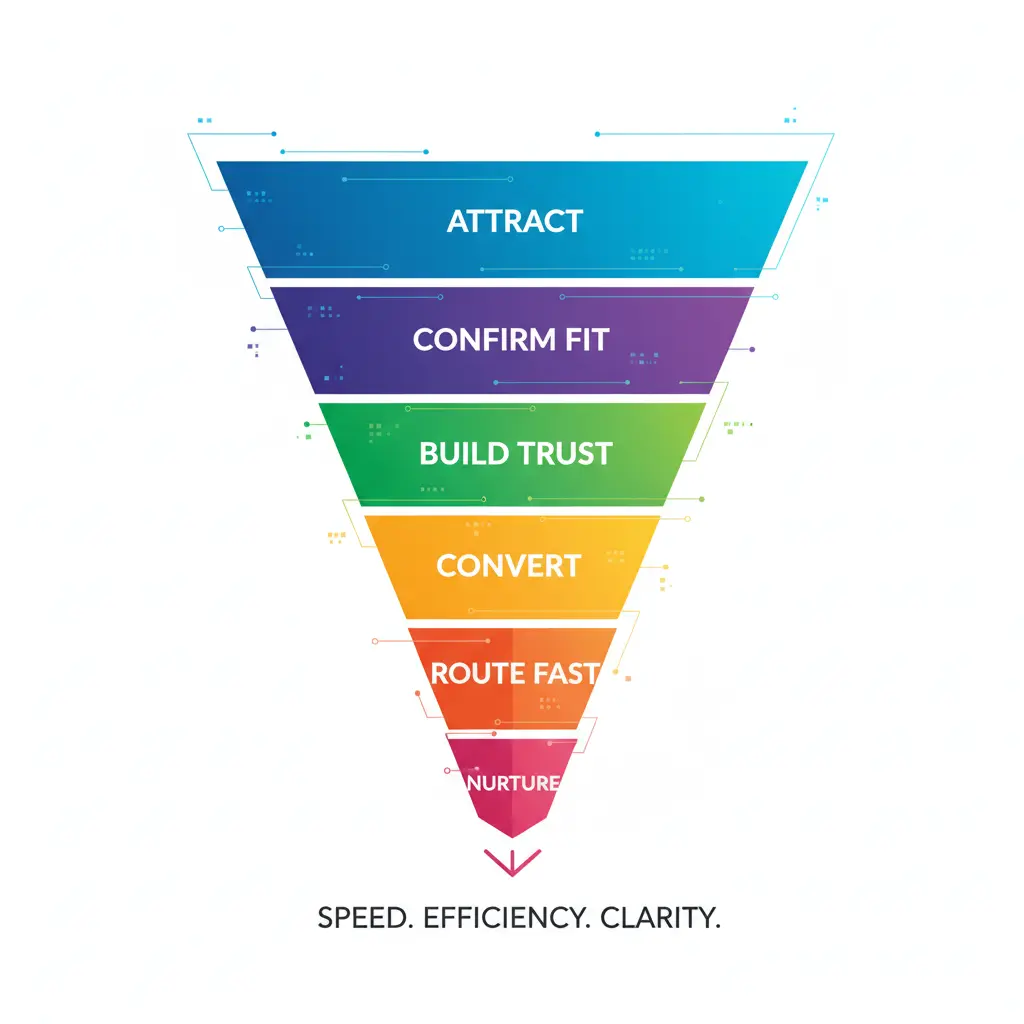
Use this simple model:
Attract → Confirm Fit → Build Trust → Convert → Route Fast → Nurture
Here’s what that looks like in practice:
Attract with Pages That Match Real Search Intent
Not just “Our Services.” You need pages that answer problems buyers actually search for.
Confirm Fit Quickly
Clear positioning: who it’s for, who it’s not for, what outcomes you drive, and what your process looks like.
Build Trust Where Decisions Happen
Proof near CTAs, proof on pricing pages, proof on use case pages, proof on landing pages.
Convert with Intent-Matched CTAs
Different CTAs for different levels of readiness.
Route Fast So Intent Doesn’t Decay
Speed to lead is a conversion lever.
Nurture the Rest
Most B2B buyers aren’t ready today. Your website should still capture them cleanly and keep you top of mind.
That’s the system. Now let’s build it piece by piece.
Which Website Pages Generate The Most Qualified B2B Leads?
In B2B, the highest quality leads usually come from high intent pages, not from generic blogs or broad “about” pages.
Prioritize these page types:
Use Case Pages
Examples: “Website Redesign For B2B SaaS,” “Webflow Development For AI Companies,” “HubSpot Setup For B2B Teams,” “SEO Optimization For Service Businesses.” Use case pages work because buyers self-select.
Case Studies
Not “we did a redesign.” Decision makers want: baseline, actions, timeline, results, and what made it work.
Pricing Page (Or Packaging Page)
You don’t need to publish exact prices for every scenario, but you do need to reduce uncertainty. Even ranges, starting points, and “what impacts pricing” increases qualified leads.
Integration Pages
If you work with HubSpot, GA4, Webflow, Salesforce, etc., these pages capture buyers who already have a stack and want compatibility.
Comparison Pages
Examples: “Webflow vs WordPress For B2B,” “Webflow Agency vs In-House Team,” “Website Redesign vs Website Refresh,” “HubSpot CMS vs Webflow.” Comparison intent is often “shortlisting,” which converts.
Demo / Consultation / Audit Landing Pages
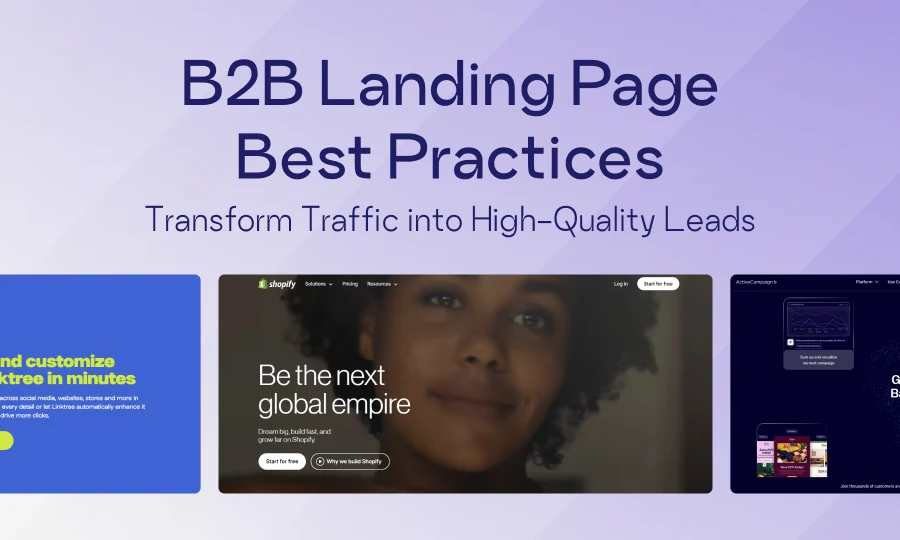
One page, one job: booking a qualified conversation. No distractions. Applying proven B2B landing page best practices can significantly improve conversion rates.
When these pages exist and are internally linked from your content, your entire site becomes a lead gen flywheel.
Pro Tip: Add one “proof strip” to every high-intent page (pricing, case studies, comparisons, integrations). Use one metric, one recognizable logo, and one specific testimonial line. It’s the fastest trust upgrade you can make without redesigning the page.
How Do You Match CTAs To Buyer Intent (So You Don’t Lose The Best Leads)?
A single CTA cannot serve every visitor.
Use CTAs that match what the buyer is ready to do now:
Top Of Funnel (Learning)
Download a checklist
Get a template
See examples
Subscribe to insights
Middle Funnel (Evaluating)
View case studies
See a process breakdown
Compare options
Explore a timeline
Bottom Funnel (Buying)
Book a call
Request a proposal
Get a teardown/audit
Talk to a specialist
Add micro clarity under CTAs, especially for decision makers:
“20 minute call. We’ll review your goals and share a recommended plan.”
“No hard pitch. You’ll leave with 3 priority fixes.”
Clarity increases conversion and filters out low intent leads at the same time.
Make Your Website Your Best Sales Rep
We’ll build or optimize your Webflow site to capture, qualify, and route leads automatically.
What Should Your B2B Lead Form Ask For (To Increase Quality Without Killing Conversions)?
Short forms convert. Smart forms qualify.
A practical “minimum viable” B2B form:
Work email
Name
Company
Role (or department)
One qualifier question
Pick one qualifier based on your sales motion:
“What are you looking for?” (Webflow build, redesign, HubSpot, SEO)
“When do you want to start?” (0 to 30 days, 30 to 90, 90+)
“Company size” (1 to 10, 11 to 50, 51 to 200, 200+)
“Budget range” (only if you genuinely route or scope differently)
What to avoid:
Too many open text fields (“Tell us everything”)
Phone number as required (unless you truly call within minutes)
Long forms on top of funnel content
How to get more quality without more fields:
Enrichment Use the email domain to infer company and enrich firmographics.
Conditional logic Show different questions based on the service selected.
Progressive profiling Ask more later, not now.
This is how you capture more leads while still improving lead quality.
How Do You Capture More Leads Without Turning Your Website Into A Pop Up Circus?
High-converting lead capture is less about “more interruptions” and more about “better timing.”
Use these capture points:
Inline CTAs Inside the Content
Add a CTA after key sections like “How much does it cost?” or “Common mistakes,” when buyers are naturally thinking about next steps.
Sticky CTAs Only on High-Intent Pages
Pricing, case studies, comparisons, and integration pages are fair game. On educational posts, a sticky “Book a call” often feels aggressive and converts worse.
Exit Intent for Top-Funnel Pages Only
Offer something useful, not generic. “Get the B2B Website Lead Capture Checklist” works. “Subscribe to our newsletter” usually doesn’t.
Chat With Guardrails
Chat is great when it qualifies first, then offers a next step. Chat that pounces on everyone is just a digital sales rep with no social skills.
Scheduling Where It Makes Sense
If someone asks for a demo or consultation, let them book immediately. If they’re reading a guide, give them a low-commitment option.
How Fast Should You Follow Up With A New B2B Lead?
Fast follow-up is one of the few levers that can double conversion without changing traffic.
A realistic speed plan:
High Intent
Examples: Demo requests, pricing inquiries, contact sales. Target: Under 5 minutes during business hours.
Medium Intent
Examples: Webinar signups, audits, templates, newsletter. Target: Same day.
Low Intent
Examples: Blog readers with no conversion. Target: Nurture sequence and retargeting.
Note: Speed only works if routing is correct. A fast response from the wrong person is still a slow path to revenue.
Pro Tip: Add an “instant confirmation” step after high-intent conversions. A simple thank-you message that sets expectations like “We’ll reply within X minutes” plus a calendar booking option increases show rates and prevents leads from cooling off while they wait.
How Do You Route Leads Automatically So Qualified Leads Don’t Get Stuck?
Routing is the invisible part of lead generation that leadership cares about and most websites ignore.
A good routing setup does three things:
1. Qualify
Based on the service selected, company size, industry, or urgency.
2. Assign Ownership
Route to the right person or team immediately.
3. Trigger the Right Next Step
Meeting booking, proposal flow, nurture workflow, or disqualification.
Practical Routing Rules That Work:
Enterprise leads go to senior sales or a dedicated rep
Certain industries go to specialists
“Start in 0 to 30 days” triggers immediate outreach
Non-ICP segments go into a nurturing track, not the sales queue
This protects your sales team’s time and improves close rates because reps focus on the right conversations.
How Do You Create Lead Magnets That Attract Buyers (Not Freebie Hunters)?
A lead magnet should make a buyer think: “This is for my job.”
The Best B2B Lead Magnets Are:
Specific
Actionable
Hard to DIY quickly
Closely tied to your paid offer
Examples That Usually Attract High-Intent Leads:
A Website Conversion Teardown Checklist
A scorecard that helps them audit their own homepage, service pages, and CTAs.
A B2B Website Messaging Worksheet
Positioning prompts that help them clarify who they’re for and what they deliver.
A Webflow Migration Timeline Template
If your audience is considering moving platforms, this captures serious evaluators.
A HubSpot Tracking Setup Checklist
If you do HubSpot work, this filters for people with real operational needs.
A generic ebook is easy to download and easy to ignore. A job-relevant tool gets used, shared internally, and creates real sales conversations.
What Should Your Website Tracking Include To Prove Lead Quality (Not Just Volume)?
If you want qualified lead generation, you need tracking that connects pages → actions → pipeline.
Otherwise, you’ll optimize what’s easiest to measure (traffic and form fills) instead of what matters (sales outcomes).
At minimum, your tracking should capture:
Source and campaign (UTM discipline, paid vs organic vs outbound)
Page path (what they viewed before converting)
CTA clicks (which CTAs drive action)
Form analytics (start rate, completion rate, drop-off fields)
Meeting booked rate (the real conversion for many B2B sites)
Lead-to-SQL rate (quality indicator)
Pipeline created and revenue influenced (lead gen truth serum)
Pro Tip: Track your “Money Page Views” as a leading indicator. Set up a simple event for visits to pricing, case studies, comparisons, and integrations and monitor the ratio: Money Page Views ÷ Total Sessions. If traffic goes up but this ratio doesn’t, you’re attracting the wrong visitors (or your internal linking is weak). If the ratio rises, qualified lead flow usually follows.
If a page drives a lot of conversions but low SQL(Sales Qualified Lead) rate, it’s generating noise. If a page drives fewer conversions but has a high SQL rate, it’s your gold mine.
How Do You Create A Content Architecture That Generates B2B Leads (Not Random Blog Traffic)?
To generate actual leads, you need a site that’s structured.
A Simple Content Architecture That Works:
1) Pillar Page
This article: the complete guide that earns rankings and links.
2) Supporting Pages (Problem And Process)
Pages that answer specific questions buyers search:
Pro Tip: Add “next-step” internal links like you mean it. Don’t link to your homepage. Link to the most relevant high-intent page with specific anchor text, like “See Webflow Migration Timeline”, “Explore Pricing Factors”, or “Book A Website Teardown”. This improves rankings (clear topical connections) and conversions (clear next action).
How Do You Generate B2B Leads With Landing Pages That Convert Decision Makers?
B2B landing pages convert when they do three things fast: clarify, prove, and guide.
Use this structure:
Above the fold: who it’s for + outcome + primary CTA
Proof: outcomes, metrics, client logos, specific testimonials
Offer clarity: what happens next, timeline, what’s included
Objection handling: pricing expectations, resources needed, common concerns
Secondary CTA: for visitors not ready to book (audit, checklist, examples)
Two rules that improve quality immediately:
One landing page should focus on one offer and one audience
Every page should answer: “Why you, why now, what next?”
This keeps the page sharp for decision makers and easy for search engines and LLMs to understand — especially when applying proven B2B landing page best practices.
Pages optimized by a best Webflow AEO/GEO agency are more likely to surface in AI-driven discovery tools that buyers use to research solutions.
How Do You Reduce Junk Leads Without Reducing Total Leads?
Filtering junk leads is usually about tightening intent, not making forms longer.
Use these methods:
Add “who it’s for” and “who it’s not for” lines near the CTA
Put ranges or starting points on pricing/packaging
Use conditional routing (different flows for different segments)
Offer a low-friction alternative CTA for early-stage visitors
Require work email on bottom-funnel forms (optional on top-funnel magnets)
This preserves conversion rate while improving lead quality because you’re guiding the wrong-fit visitors away from sales paths.
What Are The Most Important Website Conversion Metrics For B2B Lead Generation?
If you want to optimize what matters, track these in order:
High-intent page conversion rate (pricing, case studies, comparisons)
CTA click rate (by page type)
Form start rate and form completion rate
Meeting booked rate
Lead-to-SQL rate
Pipeline per 1,000 sessions
Pipeline per 1,000 sessions is especially useful because it connects SEO + conversion + revenue in one number that decision makers understand.
90-Day Plan To Generate More B2B Leads From Your Website
A clear, step-by-step plan for growing both lead volume and quality in three months:
Days 1–30: Fix High-Intent Pages and Capture Paths
Audit top pages that drive traffic: check CTAs, forms, and clarity of messaging.
Add proof near CTAs: testimonials, case study snippets, or metrics.
Shorten forms and remove friction.
Ensure leads are routed immediately to the right sales rep.
Days 31–60: Build Pages That Capture Qualified Leads
Publish use case pages for your top industries/services.
Add comparison pages for buyers evaluating alternatives.
Create integration pages for the tech stacks your audience uses.
Link supporting content (blogs, guides) to these pages so readers move naturally toward conversion.
Days 61–90: Scale What Works
Strengthen internal linking to boost high-performing pages.
Refresh older content with updated proof, metrics, and stronger CTAs.
Set up retargeting and email nurture flows for engaged visitors.
Identify funnel drop-offs and fix the steps that lose the most leads.
This plan gives marketing directors a simple, executable roadmap to increase qualified leads from the website in just three months.
How Can Creative Corner Studio Help You Generate & Capture More Qualified B2B Leads?
If you’re serious about how to generate B2B leads, your website can’t be “pretty and polished.” It has to be built to convert with the right pages, the right UX, the right SEO, and tracking that proves what’s working.
That’s exactly what Creative Corner Studio does: we design and develop high-performing Webflow websites (and SEO-optimize what you already have) so qualified visitors take the next step, forms stay frictionless, and leads get captured and routed fast.
If you want a website that’s a lead engine, not a brochure, explore Creative Corner Studio and see what we can build together.
Turn “Nice Website” Into “Booked Meetings"
Conversion-first Webflow design and build, tailored to your ICP and buying journey.
How do I generate qualified B2B leads on my website?+
To generate qualified B2B leads on your website, focus on attracting buyers with clear intent and guiding them to the right next step. This means ranking for high-intent keywords, clearly stating who your offer is for, proving credibility early, and using intent-matched CTAs such as demos, audits, or consultations. Qualified leads come from clarity and relevance, not traffic volume.
What makes a B2B lead “qualified”?+
A B2B lead is considered qualified when it fits your ideal customer profile, shows real buying intent, and provides accurate contact information that allows for timely follow-up. Lead quality is determined by fit and intent, not by how many form fields a visitor completes.
How can I improve B2B lead quality without reducing lead volume?+
You can improve B2B lead quality without reducing volume by filtering intent instead of adding friction. Clear “who it’s for” messaging, transparent expectations, and one smart qualifying question on key forms help the right buyers self-select while maintaining healthy conversion rates.
What website elements help convert B2B visitors into leads?+
The most effective website elements for converting B2B visitors include high-intent pages (such as use cases, case studies, pricing, and comparisons), clear positioning above the fold, proof near CTAs, fast load times, and short, focused forms with clear next-step expectations.
How do I capture leads on a B2B website without hurting UX?+
You can capture leads on a B2B website without hurting UX by prioritizing relevance and timing over interruptions. Inline CTAs, intent-based offers, limited use of popups, and low-commitment options for early-stage visitors allow you to capture leads while keeping the experience clean and helpful.