Key takeaways
➡ 97 percent of AI-using B2B professionals now use AI to discover suppliers, and 92 percent say it shapes their shortlist.
➡ Being well known barely helps. 7 percent notice a supplier through brand recognition, 53 percent through a precise use-case match.
➡ Assistants quote a company's own website when they explain why they recommended it.
➡ Flat website traffic can hide rising demand. One site doubled impressions while clicks stayed level.
➡ Checking once proves nothing. Repeated answers to the same question vary enormously.
How is AI search changing the B2B buyer journey?
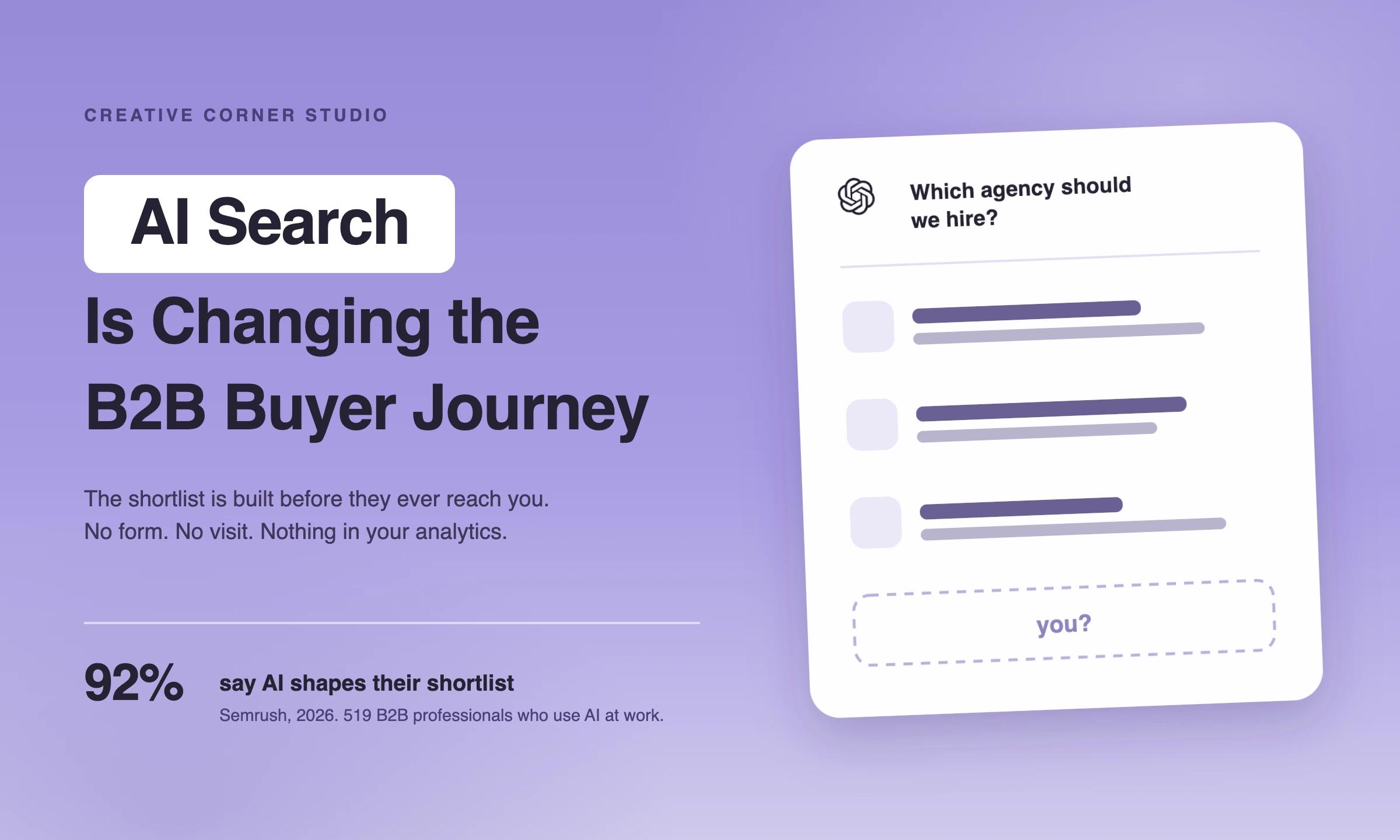
AI search is product research carried out inside an AI assistant rather than on a results page. It moves the research phase off your website. Buyers ask an assistant who to consider, compare options inside the conversation, and arrive with a shortlist already formed. In a 2026 Semrush survey of 519 B2B professionals who use AI at work, 97 percent used it to discover suppliers, 92 percent said it shaped their shortlist, and 83 percent said it influenced the final decision.
| Stage of the purchase | Share who use AI here |
|---|---|
| Discovering suppliers in the first place | 97% |
| Building the shortlist | 92% |
| Making the final decision | 83% |
Source: Semrush, How AI tools shape the B2B buying process (2026). Survey of 519 B2B professionals who confirmed they use AI tools at work.
Forty five percent of that last group said the influence was significant rather than marginal. These figures describe B2B buying broadly, not one sector, and they come from the 519 survey respondents who confirmed they use AI tools at work.
The pattern is sharpest where buyers were already self serving. In software, the question "which tool is best for a team like ours" used to be answered by review sites. It is now answered in a chat window, and the review sites have become one of the sources feeding that answer.
What does a B2B buyer actually do inside an AI assistant?
They ask about their problem, not about your product. The assistant returns a short explanation and names several suppliers. The buyer asks follow-up questions about company size, price and fit, and the list narrows. No form is filled in, no website is visited, and no analytics tool records any of it. The first signal you receive is a booked call.
By the time that person reaches your contact page the comparison is finished. You are either on the list or you are explaining why you should have been.
Why does AI recommend companies buyers have never heard of?
Because the model matches a described problem to a described capability, not a brand to its reputation. In the same Semrush survey, 53 percent of respondents said they notice a supplier because it matches their specific use case, and 50 percent because the description is clear and detailed. Only 7 percent pointed to brand recognition. The question allowed several answers.
A use-case match is the overlap between the problem a buyer describes and the capability your page describes, in roughly the same words. It is the single strongest reason a supplier gets named.
This is why established companies keep finding smaller competitors in lists they expected to lead. Fame gets you into the conversation. Precision gets you into the answer.
What does an AI assistant read before it names a supplier?
Mostly the supplier's own website, checked against third-party sources. We ran a current GPT model with live web access and asked which agencies a B2B SaaS company should hire. It named five companies and justified each one with a sentence lifted from that company's own homepage. Not one was chosen for size, revenue or awards.
One was named because its site says it offers AI search visibility. Another because its site says it is built for search, large language models and AI agents. The model read what each company claimed about itself and repeated the claim that matched the question.
Google's own guidance on generative AI features makes the same point from the other side: optimising for AI answers builds on ordinary search fundamentals rather than replacing them. PwC frames it as making content easy for a machine to find, understand and reuse.
Does falling website traffic mean falling demand?
Not necessarily. One client site moved from roughly 128,000 monthly search impressions to roughly 270,000 across sixteen months while clicks stayed broadly flat. More buyers saw the company and fewer needed to visit in order to understand it. Flat traffic in a busy market can mean your information is reaching people somewhere other than your own pages.
That is uncomfortable to report and easy to misread. A dashboard that only counts sessions will describe a company gaining ground as a company standing still.
How do you know whether AI search is working for your company?
Not by checking once. A study of 12,933 model responses across eight languages and three models found that almost 70 percent of the variation between answers was residual noise. Brand identity explained roughly 1.5 percent. A single answer, flattering or absent, tells you very little. Presence has to be sampled across many prompts and repeated over time.
That study measured the sentiment of answers rather than how often a brand was mentioned, which is worth knowing before anyone quotes it as proof of something broader. The practical lesson holds either way. Open ChatGPT once, see your name, and you have learned almost nothing.
A check you can run this week
- Write down the five questions a real customer would ask to find a company like yours.
- Run each one in two different assistants, with web search switched on.
- Record whether you appear, which competitors do, and in what order.
- Read how the assistant describes what you do, word for word.
- Repeat the same five prompts a month later and compare.
The description is usually the surprise. Most companies find the assistant explains them accurately but generically, in language that would fit any competitor, which is exactly the language that loses a use-case match.
What it looked like when it happened to us
We sell this, and we still did not see it coming.
Between June and September 2026 we took 25 new enquiries. Twenty one of them came from AI search. Two came from the Webflow partner directory, one was a referral, and one came from Google. Of the six deals we won in that period, four began in an AI answer.
Almost none of it appeared in analytics. No referrer, no campaign, no first touch. We know the split because the contact form asks, and because buyers raise it on calls without being prompted.
"I first went to the Webflow Experts page and then… it was either Claude or ChatGPT… one of the agencies that popped up."
Lauren, Lustre
For everything the form cannot see, we use Otterly. AI visibility monitoring means running a fixed set of buyer prompts across ChatGPT, Perplexity, Gemini and Google AI Overviews on a schedule and recording what comes back: whether we appear, which competitors appear beside us, and which page was cited as the source.
The third one is the one that earns its keep. Knowing you were named is a score. Knowing which of your pages produced the answer is a to-do list.
What it cannot tell you is whether any of it turned into work. A rising mention count and a flat pipeline are perfectly compatible, which is why the question on the contact form still matters.
Where to start
If the answers come back wrong, that is a structural problem rather than a content problem.
We work on how B2B companies are described, categorised and cited by AI assistants. See how that works on our AI search optimization page.
Frequently asked questions
Why doesn't our company appear when buyers ask AI about our category?
Usually because nothing on your site matches the question precisely enough. Assistants pair a described problem with a described capability. In the Semrush survey, 53 percent of buyers noticed a supplier through a use-case match and only 7 percent through brand recognition. If your pages describe what you do in language that would fit any competitor, there is nothing specific for the model to match against.
We rank well on Google. Why doesn't that carry over to AI answers?
Ranking puts you in a list. An AI answer names a few companies and omits the rest, so a strong position on page one does not guarantee a mention. Assistants also read third-party sources and your own descriptions, not only your rankings. Good search performance keeps you retrievable, which is necessary but not sufficient for being named.
Our website traffic is flat. Is that a problem?
Not on its own. One client moved from about 128,000 monthly search impressions to about 270,000 over sixteen months while clicks stayed level. More buyers saw the company and fewer needed to visit. Check impressions and branded search alongside sessions. Flat traffic with rising impressions means people are learning about you somewhere other than your site.
How long does it take to change how AI describes a company?
There is no reliable published figure, and anyone quoting one should be asked for their source. What can be said is that surfaces browsing the live web reflect a changed page sooner than descriptions resting on third-party sources and older training data, because those need the wider web to agree first. Measure it rather than assume it.
What can a marketing team fix internally, and what can't it?
A marketing team can run buyer prompts and record what comes back in an afternoon. It can also rewrite a services page so each offer reads as distinct. What it usually cannot change alone is the structure underneath: how services are split across URLs, what the entity markup states, and whether AI crawlers reach the pages at all.