Key takeaways
- Original research, run by Creative Corner Studio's SEO and AEO specialist and published on 20 November 2026. Eight head-to-head vendor questions, one constant question shape, ChatGPT with web search enabled on every one.
- Three of our eight head-to-head questions were answered with no search at all. All three were between household-name platforms. For those, nothing published on either vendor's website touched the answer.
- The other five triggered a search, and in every one of them the citations went to whoever had published a head-to-head comparison: a vendor's own page, or a third-party comparison site.
- Most B2B software companies sit below the threshold, which is good news. Below it, your pages still decide what the answer says.
- Publishing the comparison gets you quoted. It does not guarantee the recommendation. In one pair the vendor supplied four of the six citations and the recommendation still went to the other one.
- Publish nothing and somebody else describes you. In one pair, a vehicle tracking vendor's contract terms were described only by a comparison site, and what it said about those terms was the least flattering line in the answer.
- We ran three of the questions a second time. One pair flipped from searching to not searching, and the citations moved even where the search held. The competitor's comparison page was cited in both runs, which makes it the most durable thing we measured.
- The page that does this work is a comparison against a named competitor, which is a different page from a features list and a different page from a category explainer.
What decides whether an AI looks you up at all?
How well it already knows you. A model asked to choose between two famous platforms answers from what it absorbed in training and never opens a browser, which is a different failure from the one where AI answers skip your B2B website altogether. Asked about two vendors it has no settled view on, it searches, and from that moment the pages on the web decide what it says.
The visibility threshold is the point at which a model stops looking a company up and starts answering about it from memory. It behaves like a tendency rather than a hard line, as the repeat runs below show. It matters because it tells you whether your website is part of the conversation or a spectator to it. It also sits in a different place for a company everyone has heard of than for one competing in a category of six.
How we tested it
Original data. This is our own research, not a summary of someone else's. Alexandra Alexandrova, SEO & AEO Specialist at Creative Corner Studio, ran 8 head-to-head vendor questions through ChatGPT via the DataForSEO API on 20 November 2026, with web search enabled on all 8, and re-ran 3 of them the same day. The counts below are read from the returned responses. The question shape was held constant, in the form a real buyer would use: "A or B for a company of this size? Which should we pick and why?" Only the pair of vendors changed, from household names down to vendors known inside one vertical.
The measurement is simple and anyone can repeat it. Search was permitted every time, so the model's own decision about whether to use it is the finding. When a model declines to search a question it is allowed to search, it is telling you it already has an answer.
Vendors we work with appear in this sample. Where one of them is shown unfavourably we have described the pair rather than named it, and we have named the pair where neither company is a client.
Which questions were answered without a search?
Three of the eight, and the pattern in them is not subtle.
| Pair | Category | Searched |
|---|---|---|
| HubSpot or Salesforce | CRM | No |
| Pipedrive or Close | CRM | No |
| Zendesk or Freshdesk | Customer support | No |
| Vanta or Drata | Compliance | Yes |
| Two QA testing vendors | Software testing | Yes |
| Two field service vendors | Engineer scheduling | Yes |
| Two gym management vendors | Fitness software | Yes |
| Two vehicle tracking vendors | Fleet tracking | Yes |
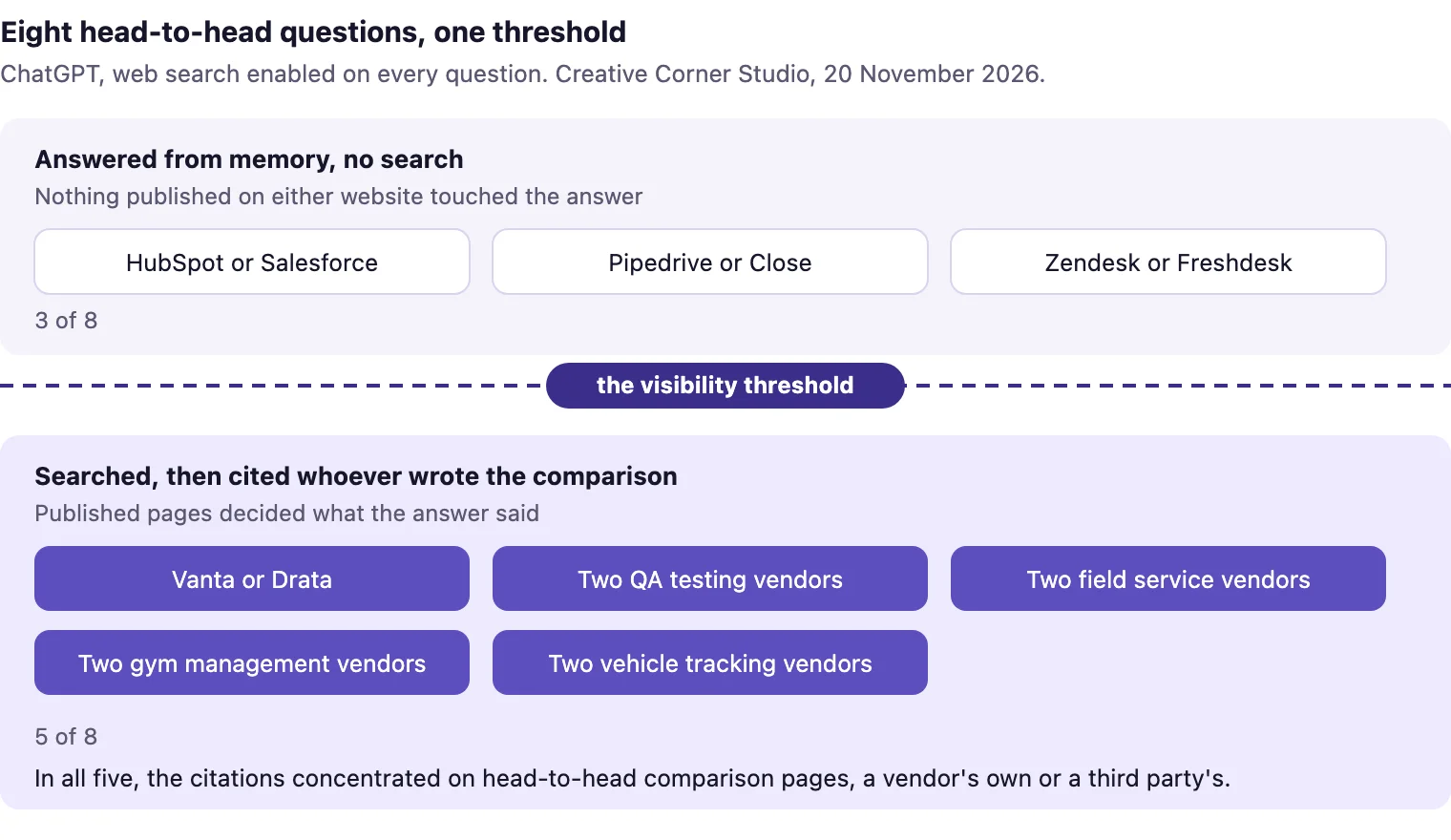
All three unsearched questions were between platforms with very large brands. The answers were competent, specific and entirely from memory: interface comparisons, scalability caveats, a recommendation. No sources, because none were consulted.
If you compete at that level, your content is not what moves this. What moves it is whatever the model absorbed before it ever met your website, and that is a longer and slower game than publishing a page.
Who gets cited when it does search?
Whoever published the head-to-head comparison. A head-to-head comparison page is a page about two named products against each other, rather than a features list or a category guide, and in all five searched questions the citations concentrated on those pages and almost nothing else.
The clearest case is one we can name, because neither company is a client. Asked to choose between Vanta and Drata for SOC 2 compliance, the model cited eight sources. Two were Vanta's own comparison page against Drata. Six were third-party comparison sites. Drata's own website was cited zero times. The recommendation went to Vanta.
Both companies are large, well funded and extensively documented. The difference in that answer was not product quality. One had written the comparison and the other had not.
A third-party fills the gap when neither vendor does. In the software testing pair, half the citations went to a single developer community's comparison article, which supplied the pricing descriptions for both companies.
This also explains something that looks odd in aggregate data. Review platforms are read constantly and credited rarely. In separate measurements of B2B software buying questions:
- Capterra was the second most retrieved domain for best project management software, and absent from the top ten cited.
- G2 was the most retrieved domain of all for best marketing automation software, and cited in none of the top ten.
A listing page describes twelve products and gives a model nothing specific to attribute. A page about exactly these two products gives it a sentence.
Does cited mean quoted?
Not reliably, and you cannot tell which from the citation. A model marks a sentence as sourced whether it reproduced your wording or rewrote it, and in the same answer it does both.
We checked this on the Vanta answer by opening the page it cited and comparing the wording line by line. One claim came through almost untouched. The model wrote that Vanta "automates policies, risk reviews, and questionnaires with a 95% acceptance rate"; the page says "The Vanta AI agent automates policies, risk reviews, and questionnaires with a 95% acceptance rate". That is a quotation in all but the attribution.
The other was rebuilt. The model wrote that Vanta "offers over 400 integrations across cloud, identity, HR, and developer tools". The same page says "Vanta features 400+ deep integrations (100+ more than Drata)". The number survived. The comparative claim, which is the entire point of the sentence on a page called Vanta vs Drata, did not. The categories were assembled from elsewhere on the site.
That has a practical consequence for how you write the page. The sentence that survived intact was a plain statement of a fact about one product. The sentence that was dismantled was an attack on a competitor. Write the claims you want repeated as standalone facts about yourself, because a competitive framing is the first thing a model rewrites out.
Does publishing the comparison win you the recommendation?
No, and this is where the advice usually oversells itself.
In the gym management pair, both vendors had published comparisons of each other. One of them supplied four of the six citations, including the description of its competitor's limitations. The recommendation still went to the competitor, on the strength of a multi-location capability the buyer's question specifically required.
So the comparison page is not a trick for winning. It decides whose words describe the category, which terms the answer is framed in, and whose prices appear. The buyer still gets a recommendation on the merits, from inside your framing rather than somebody else's.
What happens if you publish nothing?
Somebody else describes you, and they are under no obligation to be kind.
In the vehicle tracking pair, one vendor's own site was cited three times and supplied its pricing, its integrations and its support arrangements in its own words. The other vendor's website was cited zero times. Everything the answer said about that company came from third parties, including the one genuinely damaging line: a comparison site's characterisation of its contracts as non-cancellable, long and auto-renewing.
That may be accurate. It is not the sentence that company would have written about its own contract terms, and it reached the buyer as the answer to a buying question, with a citation next to it.
None of this is stable, which is an argument for doing it rather than against. Ahrefs tracked 37,500 cited websites across five AI tools and found half of AI Overview citations gone by the next day. Positions turn over constantly, and the pages that keep being picked up are the ones that answer the exact question asked.
Does it come out the same twice?
Not exactly, and we checked rather than assumed. Forty minutes after the first run we put three of the questions again, word for word, to the same model.
- The famous pair held. HubSpot or Salesforce was answered from memory both times, with no search and no sources.
- The middle pair flipped. Vanta or Drata searched and produced eight citations on the first run. On the second it did not search at all, cited nothing, and leaned the other way.
- The least known pair held, but its citations moved. The field service question searched both times. The first run produced seven citations, the second four, with a review platform appearing and one vendor's comparison page dropping out.
So the threshold is a tendency rather than a line. The less a model knows you, the more likely it is to look you up, and the likelihood is not a guarantee on any single question.
One thing survived both runs unchanged. The competitor's comparison page was cited on the first run and again on the second, while the citations around it rearranged. That is the practical finding: the page you publish about you and a named competitor is the most durable thing in an unstable system.
What should a B2B software company do about it?
Find out which side of the threshold you are on, then act accordingly. The test takes a minute: ask the model to choose between you and your closest competitor, and see whether it searches. Running it across a whole competitive set, on more than one model, and turning the result into a plan is what our AI Search Optimization work starts with.
A searched answer is one where your published pages are still in play, and that is the good case. The page that does the work is a comparison against each named competitor, and it is a specific thing:
- It names both companies, in the title and in the text, because that is the page a model looks for.
- It carries your prices, because the answer will quote a price from somewhere and the only question is whose.
- It states facts about your own product rather than attacks on theirs, since the competitive framing is the first thing rewritten out.
- It is not a features matrix and not a category explainer. Those are different pages doing different jobs.
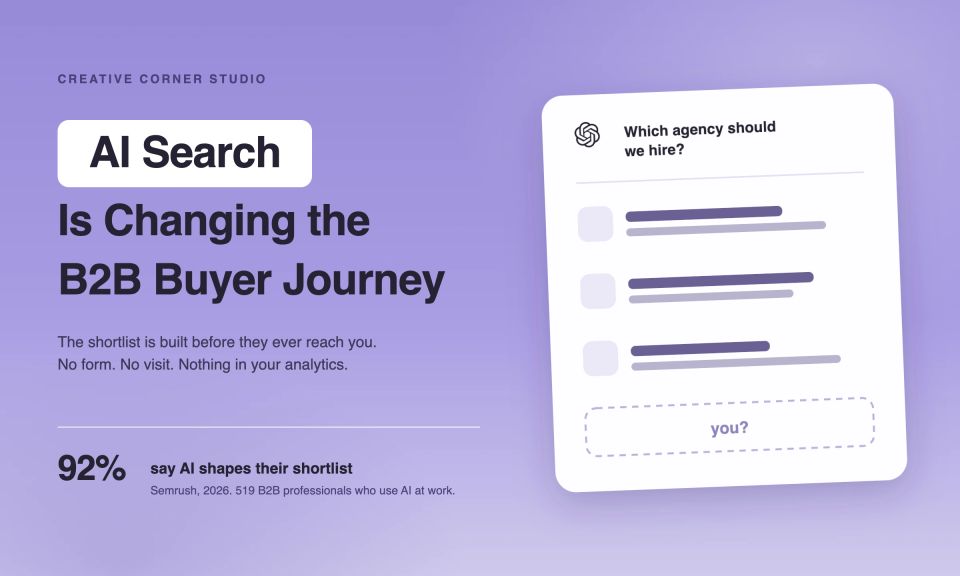
If it does not search, nothing you publish this quarter will change that answer, and the work is the slower one of becoming a name the model knows. Most companies reading this are in the first group, which is where the shift in the B2B buyer journey is doing the most damage and the most good at once.
This measurement is the first thing we run in an AI Search Optimization engagement, before any page is written, because it decides whether writing pages is the right work at all. If you are choosing someone to do it, the questions worth asking them are here.
One caveat worth keeping. Our eight questions ran on a mid-sized model, and a larger one may search more readily, which would move the threshold rather than remove it. The 12 percent overlap Ahrefs found between AI citations and Google's top ten suggests the selection is its own thing on every model, and worth measuring on the one your buyers use.