What to Ask Before You Hire an AI Search Optimization Agency
Published October 9, 2026Reading time: 11 min
An AI search optimization agency gets your company named when a buyer asks an assistant who to consider. The category is a year old, the supply arrived before the expertise, and most proposals you will read are last year's SEO deck with the word AI added. These are the eight questions that tell the two apart, with the answer you should expect and the wrong answer that tells you to keep looking.
Key takeaways
Allowing GPTBot does not make you visible in ChatGPT search answers. GPTBot governs training, OAI-SearchBot governs search, and the two are easy to confuse.
Ask how results will be measured before you ask what they will cost. If the answer is a vendor score rather than a repeatable prompt set, you cannot verify anything.
Ask whether your own facts agree with each other. Conflicting numbers across your pages do more damage than missing schema.
Google states that no special AI files are needed to appear in its AI features. Treat llms.txt accordingly.
A real answer sounds like a measurement plan. A weak one sounds like a list of deliverables.
It rarely raises conversion rate. It changes who arrives, already briefed on what you do.
More citations does not mean more clients. The prompts you win may not be the prompts your buyers type.
One thing to get out of the way first. An AI search optimization agency is the same thing as an AI SEO agency, an AEO agency or a GEO agency. The field hasn't settled on a name, and some firms pick whichever one they think sells better. The label tells you nothing. The answers below do.
These are the eight questions that separate them. Each one has an answer you should expect, and a wrong answer that tells you to keep looking.
1. Which Crawler Governs Whether ChatGPT Can Show You?
The answer is OAI-SearchBot, not GPTBot. GPTBot is OpenAI's training crawler. Its own documentation describes it as the agent used to crawl content that may be used in training its foundation models. OAI-SearchBot is a separate crawler, documented as the one that surfaces websites in search results in ChatGPT's search features. Block that one and your site won't be shown in ChatGPT search answers.
There's a third agent in the picture, and leaving it out is how this gets oversimplified.
OpenAI documents ChatGPT-User as the agent that fetches a page when someone asks ChatGPT to look at it, and says plainly that it isn't used for crawling the web automatically. Anthropic documents Claude-User the same way. Your visibility doesn't run through the search crawler alone.
Put side by side, the pattern holds across vendors: the crawler that collects training data, the one that builds search results, and the one that fetches a page on a user's request are three different agents.
Vendor
Training
Search
Fetched on a user's request
OpenAI
GPTBot
OAI-SearchBot
ChatGPT-User
Anthropic
ClaudeBot
Claude-SearchBot
Claude-User
Google
Google-Extended
Googlebot
Not documented separately
For example, a site that blocks GPTBot but allows OAI-SearchBot can still be shown in ChatGPT search answers while staying out of training data. The two are controlled independently.
The Google row is the one that catches people out. There is no separate AI crawler to allow: the same Googlebot that governs classic search governs AI Overviews and AI Mode, so blocking it to control AI exposure also removes you from Search.
Both crawlers belong to OpenAI and both appear in the same robots.txt file, which is why the difference between them gets missed so often. If you hear that unblocking GPTBot is what gets you into ChatGPT, the mechanism has been read backwards. This is the cheapest question on the list and the most revealing.
Ask them to open your robots.txt on the call and name what each line does.
2. How Will You Measure Whether It Worked?
The answer you want is a fixed prompt set, run before the work starts and again afterwards, across each assistant you care about. Twenty to forty prompts a real buyer would type. The measurement is how often you are named and what is said about you.
What you do not want is a proprietary visibility score. Scores are not comparable between vendors, cannot be audited, and tend to rise when the vendor needs them to.
Ask for the baseline before the contract, not after.
3. Can You Show Me a Page You Got Cited on, and the Prompt That Produced It?
A specific prompt, a specific assistant, a specific date, and a screenshot. AI answers vary between runs, so one screenshot proves less than a repeated test, but an agency that cannot produce even one has not measured its own work.
Treat "our clients see increased AI visibility" as a non answer. So is a traffic chart from Google Search Console, which measures a different channel entirely.
We use Otterly for this. It runs a fixed set of prompts across ChatGPT, Perplexity, Gemini and Google AI Overviews on a schedule, and records three things each time: whether we appear, which competitors appear beside us, and which page was cited as the source.
That third field is what turns a screenshot into evidence. It names the page that earned the mention, so you can see what the assistant actually read rather than guessing. Ask whoever you are talking to which of the three they record. Plenty of tools record the first and stop there.
4. Will You Fix Our Facts Before You Touch Our Markup?
This is the question almost nobody asks and the one that matters most. If your own pages disagree about how old your company is, how many clients you have, or how big your biggest project was, a model does one of two things. It lowers confidence and hedges, or it picks a version at random.
Both are worse than being absent, because the answer it gives is one your prospect can check.
Three right and one wrong is the usual shape of this. Nobody reads their own pages side by side, so the odd one out survives. Which is why a number has to be the same everywhere, not merely right somewhere. A model doesn't read your site the way you wrote it. It retrieves whichever passage answers the question in front of it, and that may be the one page you forgot.
A fact that is correct on nine pages and wrong on the tenth isn't ninety percent correct. Nothing can rely on it. An assistant that can't rely on it will either hedge or hand your buyer the wrong version.
It costs nothing to be consistent and it's expensive to be caught.
The number, the date, the client count and the price should match on every page, in every schema block, and in anything you publish off site. One list, checked once, applied everywhere.
The fix is a single internal list of agreed facts, applied across every page, before any structured data work begins. An agency that starts with schema and never audits your numbers is tidying the markup around a contradiction. This fact reconciliation is the first stage of our own AI search optimization work, for exactly this reason.
5. What Is Your Position on llms.txt?
llms.txt is a proposed convention, a Markdown file at the root of a site that lists its most important pages for language models to read. The honest position is that no major assistant has documented reading it at the moment a query is answered.
In June 2025 Google's John Mueller said publicly that no AI system was using llms.txt at the time. Reports since then that some crawlers fetch it are anecdotal, and unconfirmed by the companies involved.
It is cheap to publish and genuinely useful internally, as a single canonical statement of your facts. That is the whole case for it.
An agency presenting llms.txt as a driver of citations is ahead of the evidence. The same applies to anyone who promises that adding schema causes AI recommendations. There is no reliable public measurement of that.
6. Is There a Sentence on Our Homepage That Says What We Are?
Models quote. In our own test of five named agencies, the model justified every one of them with a sentence taken straight from that company's homepage, in the form "X is a Y for Z". Five is a small sample, but the pattern held across all five.
Most B2B homepages do not contain that sentence. They open with a positioning line that carries no company name and no category noun. The fix takes an hour and sits in the first forty words of the page.
Ask the agency to read your homepage out loud and find the sentence. If they cannot, that is the first deliverable.
7. Does Our Schema Describe What Is Actually on the Page?
Structured data is a description of visible content, not an addition to it. A price that exists only in markup, a claim with no source on the page, a service you no longer sell: each is a mismatch, and each is the kind of thing that gets markup ignored.
This is more common than it sounds. Repricing a service and leaving the old figure in the schema is an ordinary mistake that nobody notices, because the wrong number is invisible to everyone except machines.
Ask them how they will check that markup and page agree, and how often.
8. What Is the First Leading Indicator, and When Should We See It?
Off site brand presence moves slowly. On page work does not. A reasonable answer separates the two. Technical and structural work shows up within weeks: crawler access, entity clarity, passages that extract cleanly. Being named in answers depends partly on how often your brand appears in places you do not control, which moves over months.
What you want is a named first signal, measurable without re-running the whole audit. The number of prompts in your set that name you, checked monthly, is a defensible one.
Be suspicious of a timeline with no leading indicator in it.
How Do You Choose an AI Search Optimization Agency?
Whether they call themselves an AI SEO agency or an AI search optimization agency, score the eight answers above, then weight two of them heavily. Question 2, how they'll measure, tells you whether you'll ever know if it worked. Question 4, whether they fix your facts first, tells you whether they understand the order the work goes in.
Everything else is a tie breaker. Price, case study logos and certifications are easy to present and tell you little. A measurement plan is hard to fake.
If two agencies answer well, pick the one whose own site you can find in an AI answer.
When Should a Business Hire an AI SEO Agency?
Hire when buyers in your category are already asking assistants and you are not in the answers. Test that before you spend anything: run ten prompts a real buyer would type, in ChatGPT and Perplexity, and see whether you are named. That test costs nothing and settles the question.
Hire later if your site cannot be crawled, your facts contradict each other across pages, or you have no case studies. Those are prerequisites, not deliverables, and an agency charging a retainer to discover them is charging you to find your own problems.
How Does an AI Search Optimization Agency Increase Conversions?
It usually does not increase conversion rate. It changes who arrives. Someone who reaches you through an AI answer has already been told what you do, who you work with and roughly what you cost. They arrive further along than someone who clicked a blue link, so the same page converts better without changing. The honest framing is pre-qualification rather than optimization.
More citations does not mean more clients. Citation count is a number that can rise while nothing changes in your pipeline, because the prompts you win may not be the prompts your buyers type. Ask which prompts matter before anyone counts anything.
What it does not do is fix a page that fails to convert the traffic you already have. If your current organic traffic converts badly, that is a different problem and a cheaper one.
Does It Work for B2B Lead Generation Specifically?
It fits B2B better than most channels, because B2B buying involves a shortlist, and assistants are increasingly where shortlists get built. What matters is being named among three or four options, not ranked first among ten. This is the strongest case for hiring an AI search optimization agency for B2B lead generation.
The practical difference from classic lead generation is attribution. A buyer who met you in an AI answer often arrives later by brand search or direct, so the channel under-reports. Agree before you start how that will be counted, or the work will look like it failed.
Which Companies Does This Work Best For?
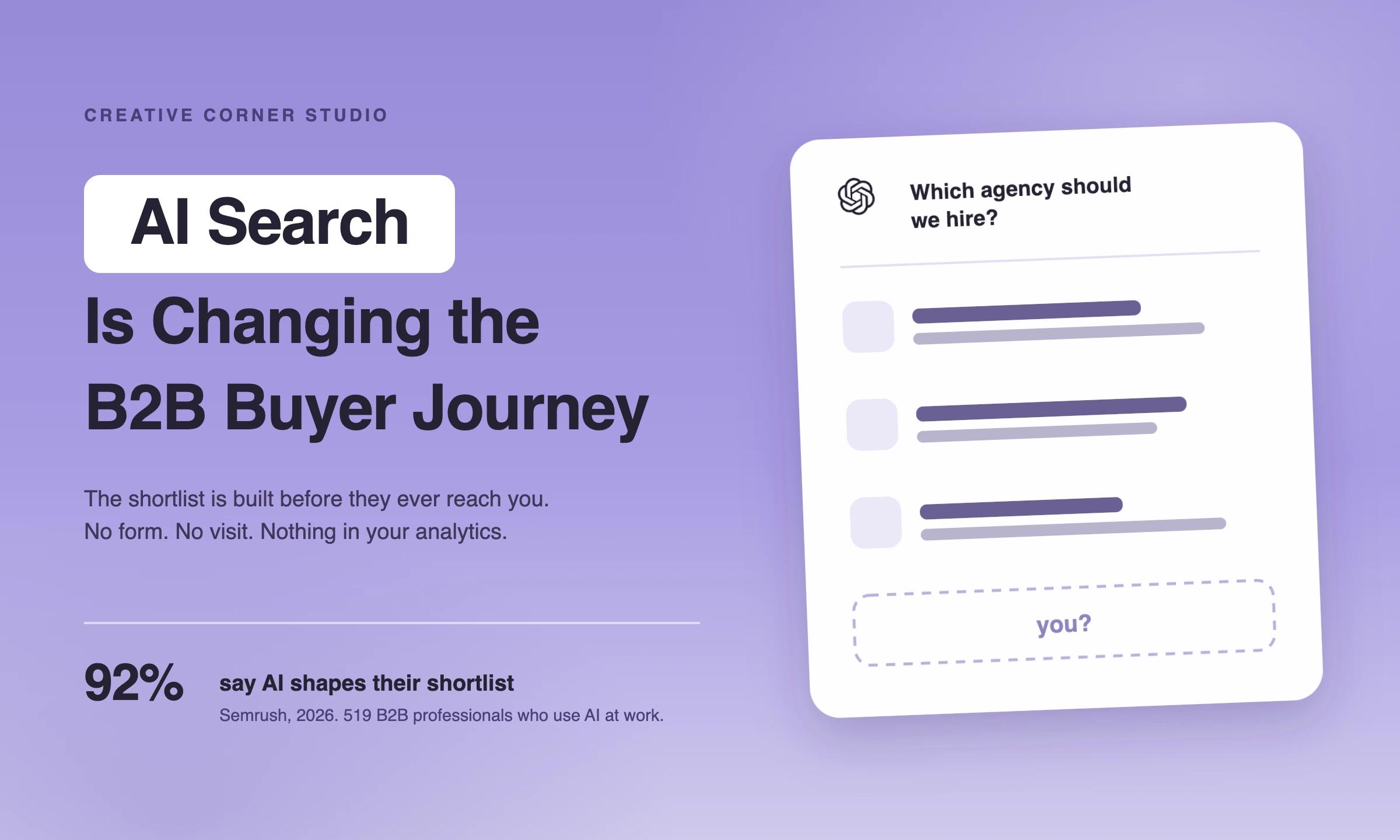
SaaS companies are the clearest fit. Assistants are asked to compare tools constantly, the category vocabulary is settled, and the buying committee researches independently before anyone talks to sales. B2B software is where this work pays back fastest, because the shortlist is built before you ever hear from the buyer.
Enterprise and large complex sites benefit differently. The gain there is usually entity clarity rather than reach, because a large site often says contradictory things about itself across hundreds of pages, and resolving that is both the hardest and the highest value part of the work.
No, and be careful with anyone who says it will. Being cited in an AI answer often produces no click at all, because the answer satisfies the question. The value is appearing in the consideration set, not a traffic number. Separately, classic SEO work done during the same engagement may grow traffic, which makes attribution messy if nobody agreed the measurement up front.
If fast organic traffic is the goal, say so, and judge the proposal on its SEO merits rather than its AI framing.
The Quick Version
Ask
A good answer
A bad answer
Which crawler lets ChatGPT show us?
OAI-SearchBot, and GPTBot is training
"We will unblock GPTBot"
How will you measure it?
A fixed prompt set, before and after
A proprietary visibility score
Show me a citation
Prompt, assistant, date, screenshot
A Search Console chart
Will you fix our facts first?
Yes, before any markup work
Starts with schema
What about llms.txt?
Cheap, no documented consumer
"It drives citations"
Is the entity sentence on our homepage?
Reads it back, or flags that it is missing
Does not know what you mean
Does schema match the page?
Describes the audit
Treats markup as separate
First leading indicator?
Prompts naming you, checked monthly
A timeline with no signal
What a Good Answer Sounds Like
A real answer sounds like a measurement plan. It names what will be checked, how often, and what would count as failure. It separates what is known from what is correlation. It says "we do not know" about causation, because nobody does.
A weak answer sounds like a list of deliverables. Schema, llms.txt, content restructuring, FAQ markup. Those are tasks, not outcomes, and a list of tasks cannot be wrong, which is exactly why it is worth nothing to you.
If you want to see the shape of a measurement plan before you talk to anyone, our AI search optimization page sets out the prompt set method and what the first month reports. If you would rather just ask, get in touch.
Sources
Every claim about crawler behaviour above comes from the companies' own documentation rather than secondary reporting. All three were read on 9 October 2026.
OpenAI, Bots. Documents GPTBot, OAI-SearchBot, ChatGPT-User and OAI-AdsBot, and states that a site blocked from OAI-SearchBot will not be shown in ChatGPT search answers.
Google, AI features and your website. States that robots.txt directives for Googlebot are the control for site owners, and that you do not need to create new machine readable files, AI text files, or markup to appear in these features.
The statement that no AI system was using llms.txt is attributed to Google's John Mueller in June 2025. Reports since then that some crawlers fetch the file are unconfirmed by the companies involved, and are not relied on here.
Frequently asked questions
What does an AI SEO agency actually do?
The work splits three ways. Technical access, meaning crawler permissions and server rendered content. Entity clarity, meaning consistent facts and structured data that matches the page. Content structure, meaning passages that answer a question cleanly enough to be quoted. Off site brand presence is a fourth, and it is the slowest.
How is this different from SEO?
Classic SEO is still required. A page that cannot be crawled or indexed cannot be cited either. The difference is the target: SEO aims at a ranking position, AI search optimization aims at being the source an answer quotes and credits.
How much should it cost?
Published pricing in this field is rare, which makes comparison hard. Creative Corner Studio prices its AI search optimization sprint at $4,900 fixed for the full four to six week engagement, with ongoing optimization from $1,700 a month on retainer.
How long before anything changes?
Technical and structural work shows up in weeks. Being named in answers depends on signals outside your site and moves over months. Ask for the leading indicator rather than the end date.
Does structured data cause AI recommendations?
There is no reliable public measurement showing that it does. It is a hygiene and disambiguation argument: structured data helps a machine read the page correctly, which is worth doing on its own terms. A promise that markup causes recommendations is a claim that has run ahead of the evidence.