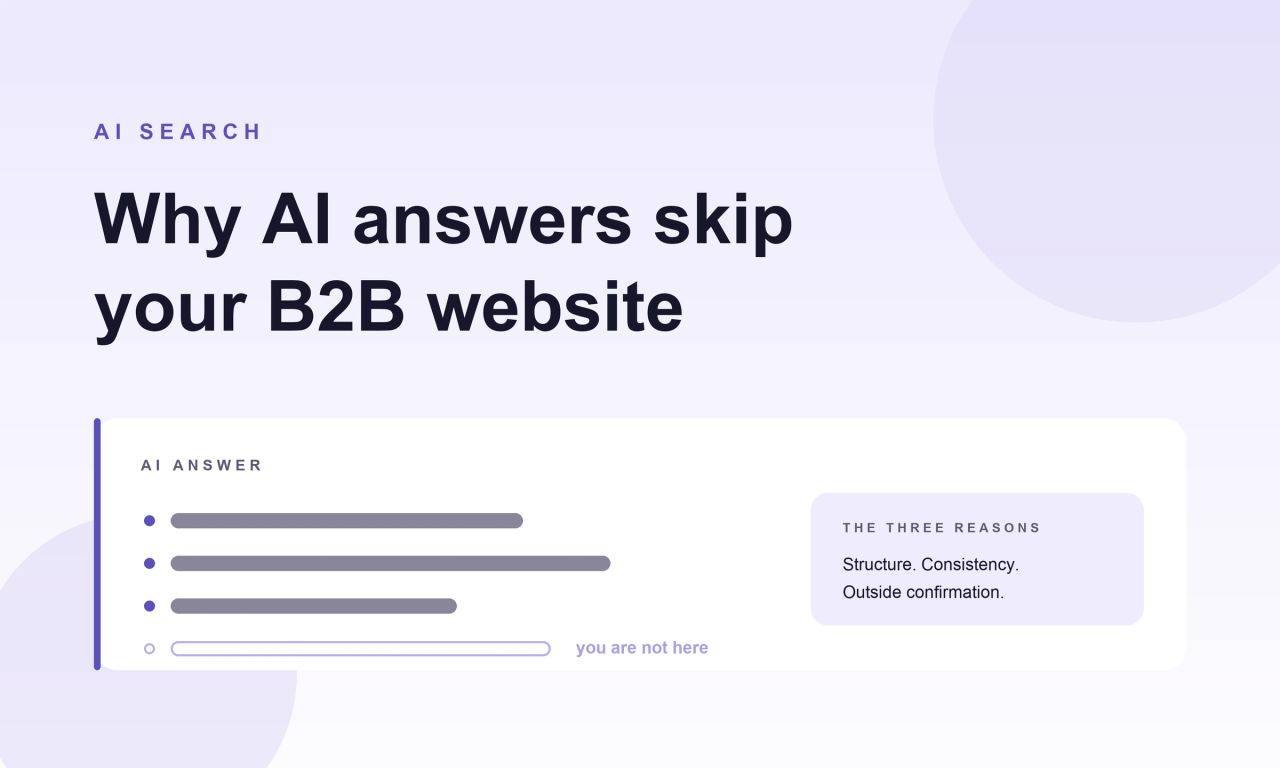
AI answers skip most B2B websites for three reasons, and none of them is content quality. The site is not structured so a passage can be lifted out of it. The business is described in words only its own team uses. And nothing outside the site confirms what the site claims. AI engines assemble answers from sources they can parse, recognize and cross-check. A well written page that fails any one of those three stays invisible, however good it reads.
This is written for marketing teams rather than search specialists. It is the same order of work we run for clients, with the parts that matter to a B2B site called out.
What AI engines actually read on your site
Not the whole page. AI systems retrieve passages, not documents. The practical consequence is that a 2,000 word page gets judged on whichever 60 words answer the question, and everything else is ballast.
Five signals decide whether those 60 words can be found and trusted.
| Signal | What it means in practice |
|---|---|
| Extractable structure | A direct answer in the first 50 to 100 words, headings phrased as questions, short paragraphs, lists and tables |
| Machine-readable markup | Schema markup that labels what the page is, so a parser does not have to guess |
| Entity clarity | Entity SEO: a consistent description of who you are, matching across your site, your profiles and third-party listings |
| Crawler access | Server-rendered content, and AI crawlers not blocked. An llms.txt file, a plain text summary of a site placed at its root for AI crawlers to read, is optional and ignored by Google Search |
| Outside confirmation | Roundups, directories, review platforms and forum threads that say the same thing your site says |
Most B2B sites we audit pass the first two and fail the last three. That is the usual shape of the problem.
Why AI answers favor simple offers over complex ones
There is a structural bias here that generic advice does not mention, and it is the part B2B teams feel most.
A short, definable offer summarizes cleanly. A model can compress "project management software for construction teams, from $29 a user" into one sentence without losing anything. A consulting engagement with a discovery phase, a variable scope and a price that depends on the answer cannot be compressed the same way. When a model cannot summarize you safely, it reaches for a competitor it can.
Long sales cycles produce less public discussion. Consumer purchases generate reviews, Reddit threads and comparison videos in volume. A six month enterprise evaluation produces a signed contract and silence. AI engines lean heavily on third-party consensus, and in B2B there is simply less of it to lean on.
Niche vocabulary has thin coverage. If your category has 200 serious buyers worldwide, the language around it is rare in training data. The model has seen the words, but not enough examples to be confident about who leads in that space.
Buying committees ask questions no single page answers. A B2B purchase involves a practitioner, a budget holder and often procurement or security. Each asks something different. Sites built around one buyer persona answer one of those three questions, so they get retrieved for one query and skipped for the rest.
None of this is a reason to give up on the category. Semrush, analysing where ChatGPT takes its citations from, found that business and service sites make up 50 percent of them, ahead of news and media at 9.5 percent and blogs at 8.3 percent. Sites like yours are already the largest single source. It is a reason to build differently from the consumer playbook most AI search advice is written against.
What should you fix first, and in what order?
The order matters more than it looks, because steps 1 and 2 decide whether anything later is measurable. Creative Corner Studio runs these in sequence as an AI search optimization sprint.
- Establish a baseline before touching anything. Pick the prompts your buyers actually use and record what AI engines answer today, including who gets named instead of you. Without this, you cannot tell later whether a change worked or the model simply shifted. Done when: you have a dated record of every tracked prompt and its current answer.
- Check that AI crawlers can reach the content. Confirm the answer text exists in the server response rather than appearing after JavaScript runs, and confirm no crawler is blocked in robots.txt. A site that looks fine in a browser can be empty to a parser. Done when: the page source, viewed without JavaScript, contains the sentences you want quoted.
- Rewrite the opening of every page that should be quotable. One direct answer, stated in the first 50 to 100 words, in plain sentences. No throat clearing before it. Done when: someone who reads only the first paragraph can repeat your answer correctly.
- Convert comparisons into tables. Pricing tiers, options, differences between approaches. Tables are lifted intact more often than prose that says the same thing. Done when: every comparison on the site is a table rather than a paragraph.
- Make the headings match the questions. Phrase H2s as the question a buyer asks, then answer immediately underneath. Semrush measured that more than 88 percent of queries triggering an AI Overview are informational, across October 2024 to March 2025, so question-shaped content is what these surfaces are built on. Done when: your heading list reads like a list of real questions.
- Add the structured data that applies. Organization, Article, FAQPage and BreadcrumbList, each matching what is visible on the page. Done when: the markup validates and every claim in it also appears in the visible copy.
- Make the entity consistent everywhere. One description of the company, repeated word for word on the site, in schema, on partner profiles, on review platforms and in any directory listing. Variations read as different companies. Done when: a search for your company name returns the same sentence in several places.
- Answer all three committee members. Separate pages or sections for the practitioner question, the budget question and the security or procurement question. Done when: each of the three can find their answer without reading the other two.
- Publish the numbers competitors hide. Prices, ranges, timelines, team size. AI engines need a source when a user asks what something costs, and they cite whoever published it. Done when: a buyer can estimate the cost and duration of working with you without contacting you.
- Build the outside confirmation. Get listed and described accurately where your category is discussed, and correct the listings that carry stale facts about you. Done when: the third-party sources that rank for your category describe you the way you describe yourself.
- Re-run the baseline and compare. Same prompts, same engines, recorded on the same schedule. Done when: you can show a before and after on the same list of prompts.
Steps 9 and 10 are the ones B2B teams skip and the ones that move results most, because they are the two that happen off the website.
How to tell whether it worked
Measurement is the part most teams are unprepared for. There is no position 3 to report. Zero-click search means the answer is delivered and the user never arrives, so traffic alone understates what happened.
What we track instead, across a fixed set of prompts and five AI platforms:
- In how many of the tracked prompts the brand is named at all
- In how many it is named first, or named alongside competitors
- Which page or third-party source the engine cited
- Whether the description the engine gives is accurate
- How the same prompt differs between AI Overviews, AI Mode and the chat assistants
AI Overviews is the summary block that appears above Google's normal results. AI Mode is Google's separate conversational experience, where someone keeps asking follow-up questions instead of scanning links. The two cite different sources for the same question.
Most of that does not fit a traditional SEO report, which is why teams struggle to show progress to their own leadership. A workable monthly format is four rows, not forty.
| What to report | Why leadership cares |
|---|---|
| Share of tracked prompts where we are named | The closest thing to a ranking that still exists |
| Which competitors are named instead | Turns an abstract metric into a competitive one |
| Whether the description given is accurate | A wrong description costs more than no mention |
| Which of our pages or which third-party source was cited | Shows where to invest next |
The difference between engines matters more than it sounds. The same site is not treated the same way by every one of them, so a single score hides more than it shows.
Do you still need to rank in Google to be cited?
A widely repeated claim says most AI Overview citations come from pages already ranking in Google's top 10. It was true, and it is now out of date.
| Where AI Overview citations rank | July 2025 | March 2026 |
|---|---|---|
| In the organic top 10 | 76.10% | 37.9% |
| Positions 11 to 100 | 9.50% | 31.2% |
| Not in the top 100 at all | 14.40% | 31.0% |
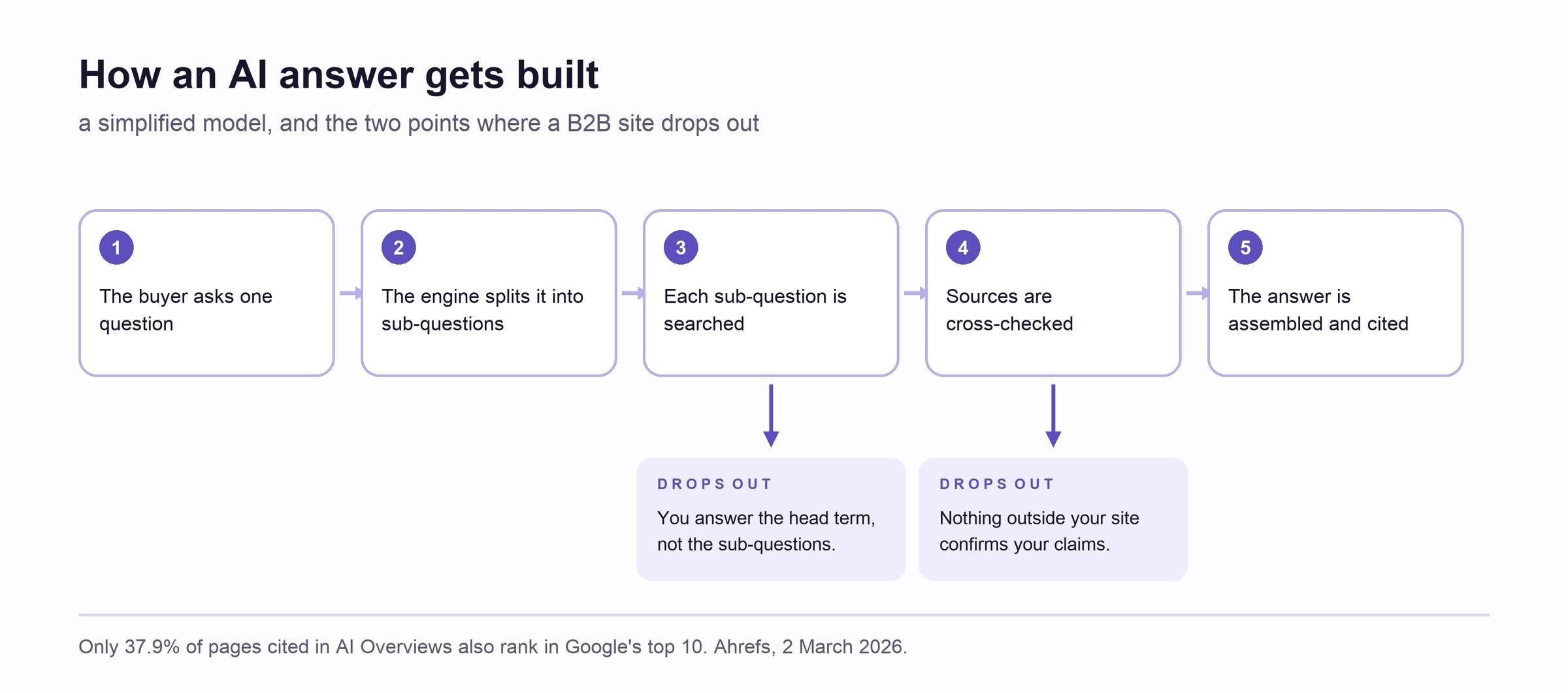
Both figures are from Ahrefs. The first was published on 21 July 2025, across 1.9 million citations from 1 million AI Overviews. The second was published on 2 March 2026, across 863,000 search results and 4 million cited URLs. Ahrefs attributes the shift to AI Overviews drawing on fan-out queries, where the engine splits a question into sub-questions and searches each one separately, rather than citing from the result page for the original query. It also notes that its own parsing and model changed between the two studies, so the comparison is not exactly like for like.
Treat the exact percentage as approximate. It depends on what the study counts, and Ahrefs published both ways of counting.
| What the March 2026 study counts | In the top 10 | Positions 11 to 100 | Not in the top 100 |
|---|---|---|---|
| Every block on the result page | 37.9% | 31.2% | 31.0% |
| Standard organic listings only | 37.1% | 26.2% | 36.7% |
The figures move. The conclusion does not.
The practical reading for a B2B site is that position is no longer the entry ticket. Close to two thirds of what gets cited now sits outside the top 10 for the question being asked, and almost a third ranks nowhere in the top 100. That puts the weight on the signals above that have nothing to do with position, which is also why answer engine optimization, the work of making a page easy for an AI to quote accurately, is not simply classic search work under a new name.
Source: Ahrefs, 2 March 2026 and Ahrefs, 21 July 2025.
Four mistakes we see on B2B sites
Each of these cancels out work done elsewhere on the site, which is why they are worth naming on their own.
Writing for the buyer who is already convinced. Most B2B sites open with positioning. The first paragraph says what the company believes, and the answer to the actual question arrives in paragraph four. That page can rank and still never be quoted, because the quotable sentence is buried below the part a retriever reads.
Describing the company differently in every place it appears. A sentence on the website, a shorter one on the partner profile, something else again on a directory listing written three years ago by someone who has left. Each variation gives an engine a slightly different company to reason about, and the cheapest fix in this entire list is making them identical.
Treating the glossary or resource section as filler. Definition pages are among the most quotable assets a B2B site can own, because they answer a question in a fixed form. They stop working when nothing else on the site links to them, since an engine has little reason to treat an unreferenced page as authoritative.
Assuming the CMS handles it. A modern platform gives you clean markup and fast pages, which covers the technical floor. It does not decide whether your first 50 to 100 words contain an answer, whether your pricing exists as a table, or whether your description matches the one on a third-party listing. On Webflow specifically, CMS collections make consistency easy to achieve and easy to forget: one field edited in one collection item leaves every other item saying the old thing.
How long before anything changes
Crawling and re-indexing is the fast part. Structural edits to a page can be picked up within days. What takes longer is the outside confirmation in step 10, because it depends on other people publishing, and on stale listings being corrected one at a time.
Our sprint runs 4 to 6 weeks and covers steps 1 through 9. Step 10 continues monthly after that, because it never really finishes. A realistic expectation is that structure changes show up first, and naming in AI answers follows once the outside sources agree with the site.
We do not guarantee citations, and nobody credible does. The engines change, and the same prompt can return a different answer in a week. What is measurable is whether your site can be parsed, whether your description is consistent, and whether anything outside your own domain confirms it. Those three are in your control.
If you are planning a rebuild at the same time, it is worth reading what a Webflow build costs before deciding the order of work, because structure is far cheaper to get right during a build than to retrofit afterwards.