What Webflow maintenance services cost, in short
Webflow maintenance services are usually sold as a monthly retainer. As a rough orientation, the monthly figures quoted for a B2B marketing site tend to fall somewhere between $2,000 and $5,000, though the spread is wide enough that the number on its own settles nothing. Our own prepaid hours start at $2,400 a month. But the monthly figure on its own tells you very little, because it is a function of how many hours it buys. Converted to an hourly basis, agency retainers, freelancers and an in-house hire all sit inside the same band. The decision is about continuity and idle time, not about rate.
What do Webflow maintenance services cost per month?
There are two pricing models in common use for ongoing work, and they are not interchangeable.
Prepaid hours. You buy a block of hours each month and draw against it. We price ours on a ladder: 20 hours at $120 an hour, 40 at $100, 80 at $90, and 120 or more at $70. That puts the entry point at $2,400 a month, with no minimum term. Unused hours roll over and stay valid for twelve months, which matters more than it sounds — a marketing site's workload is not evenly spread across the year.
Monthly subscriptions. A flat fee covering a stream of requests. Ours are $4,900, $7,600 and $9,900 a month, on a three-month minimum and cancellable at any time after that, with 5% off a six-month term and 10% off twelve. The minimum is the real difference between a subscription and prepaid hours, and it is the thing to check first in anyone's pricing. The word "unlimited" appears a great deal in this part of the market and it is worth reading carefully: what is unlimited is the number of requests you may submit, not the capacity to deliver them. Everyone in this business works in hours. The hours set the speed, and a plan that will not tell you how many hours it contains is not telling you how fast it moves.
None of these include Webflow's own site plan, which is billed separately by Webflow and is a platform cost rather than a service cost. If an agency's quote does not separate the two, ask.
Is a maintenance retainer cheaper than an in-house Webflow developer?
On an hourly basis, no. It is slightly more expensive, and the comparison that says otherwise is comparing different units.
The US Bureau of Labor Statistics puts the median wage for web developers and digital designers at $99,520 a year, or $47.85 an hour, in its May 2025 estimates. That is the number most comparisons stop at, and it is not what the employee costs you.
The same agency publishes what employers actually spend. In its Employer Costs for Employee Compensation release for June 2026, wages and salaries account for 70.0% of total compensation in private industry, and benefits for the remaining 30.0% — $32.82 of wages inside $46.89 of total cost per hour worked. Benefits here are not perks. They are payroll taxes, paid leave, insurance and retirement: the things an employer pays and a contractor does not.
Apply that ratio to the developer wage and you get the figure nobody publishes:
$47.85 median hourly wage
    ÷ 0.70 wages as a share of total compensation
    = $68.36 per hour worked
Three things about that number, so you can judge it. It is derived rather than published — we have shown the arithmetic so you can check it. It is a national median for web developers generally, because the BLS does not count Webflow developers as a separate occupation. And it is per hour worked, not per hour paid: paid leave is already inside the 30%, so there is no need to divide an annual salary by 2,080 and pretend every one of those hours is productive.
Set it against the alternatives and the result is flatter than the marketing on either side suggests.
| Model | Cost per hour worked | Basis |
|---|
| Freelancer, beginner | $30 | Upwork, typical rates |
| Freelancer, intermediate | $59 | Upwork, typical rates |
| In-house developer, fully loaded | $68.36 | Derived from BLS wage and benefit data |
| Agency prepaid hours (ours) | $70 to $120 | Our published rate ladder |
| Freelancer, advanced | $140 | Upwork, typical rates |
Upwork's figures are worldwide and drawn from past contracts on its own marketplace, so they are not directly comparable to a US salary; they are the best public numbers there are for freelance Webflow work. Even allowing for that, the picture holds. Four ways of buying the same skill, and they converge.
What the table does not show is the part that decides the question. The $68.36 is what an hour costs while someone is working. An employee is paid the same in a month with nothing to do as in a month full of launches, so the real cost per hour of work rises with every hour that is not needed. At 160 hours a month of genuine work the hire is the cheapest option available. At 20, the same salary divided across those 20 hours puts the effective rate far above anything in this table. Nobody is paid to be idle on a retainer or a freelance contract, and that, not the rate, is the whole of the difference.
Why the hourly comparison is the wrong one
If the rate is roughly the same everywhere, then rate is not the question. The question is what happens in the hours when nothing is being built.
An employee is paid in those hours. That is the deal, and for a company with a steady 160 hours a month of website work it is an excellent one — the per-hour cost is as low as it gets and the person is yours. For a B2B marketing site needing ten or fifteen hours a month, you are paying full time for part-time work, and the per-hour cost quietly multiplies.
A freelancer is not paid in those hours, which is the point of hiring one. The cost is paid elsewhere. Each engagement starts with an explanation: how the CMS is structured, which collections feed which templates, what the custom code does, why that one interaction is built the way it is. On a small fix that overhead is invisible because it is folded into the quote. Across a year of small fixes by different people, it is most of what you paid for.
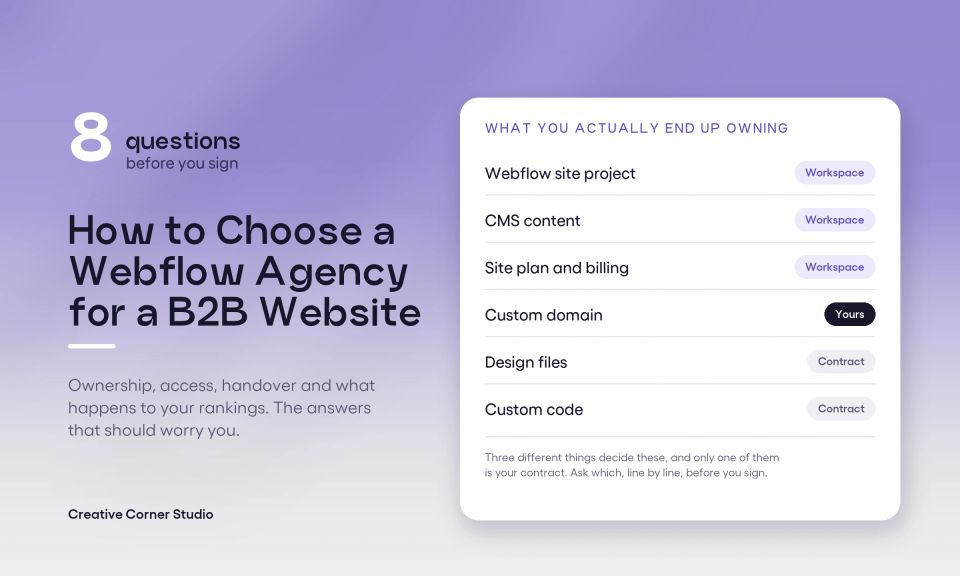
A retainer is the arrangement that tries to hold both ends: no idle hours on your payroll, and no re-explaining. Whether it succeeds depends entirely on whether the same people stay on your site, which is a fair question to ask an agency before signing and a question we cover in more detail in our guide on how to choose a Webflow agency for a B2B website.
That is the honest case for Webflow maintenance services, and it is not a case about price. What you are buying is not an hour of work. It is a team that already knows your site when the hour starts, and that you are not paying in the months when there is nothing for it to do. Work bought one task at a time is cheaper per task and more expensive per year, because every task begins at zero. A partnership is the opposite trade: you give up the lowest possible price on any single fix in exchange for never explaining your site again.
How many hours a month does a B2B Webflow site actually need?
Fewer than a full-time developer can fill. A full-time hire is paid for roughly 160 worked hours a month, and a B2B marketing site does not generate that on an ongoing basis. A redesign or a migration does, but those are projects with an end date, not maintenance.
That is the whole of the in-house problem, and it is not about the rate. You can hire someone excellent at $68.36 an hour worked and still pay them through the weeks when the site needs nothing, because a salary does not pause between campaigns. The work arrives in bursts — a launch, a campaign, a quarter-end push — and then goes quiet.
The right number depends on how much your marketing team ships, so the most useful starting point is your own last six months rather than a benchmark.
A site that changes a few times a year needs no ongoing arrangement of any kind — retainer, subscription or employee. Buy the hours when you need them.
The threshold worth knowing is the one above: the point where the work reliably fills a full-time role. Until it does, an employee is paid for availability rather than output, and the cost of each hour of real work rises with every hour nobody needed.
What is included in Webflow maintenance services?
The scope varies more between agencies than the price does, which is why two quotes at the same monthly figure can mean very different things. The work that genuinely recurs on a B2B Webflow site is:
- Technical troubleshooting. Custom code that breaks after a browser update, integrations that stop firing, forms that silently fail.
- Performance and Core Web Vitals. Image handling, script loading, and the slow accumulation of third-party tags that marketing teams add and nobody removes.
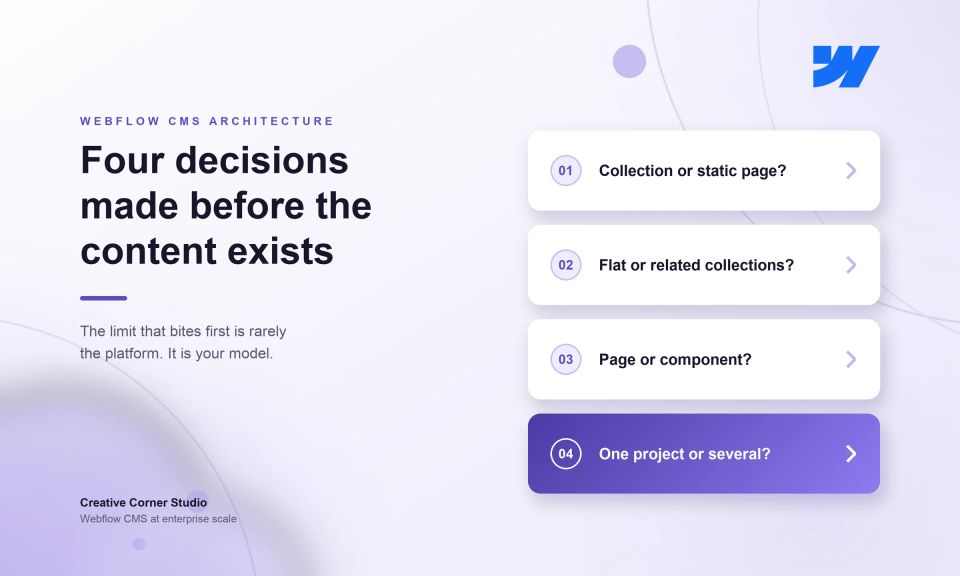
- CMS work. Collection structure that has to change as content grows, and keeping the Editor usable for people who are not developers.
- Technical SEO and AEO. Metadata, schema, sitemaps, internal linking, and structuring pages so they can be quoted by AI answer engines as well as ranked.
- Landing pages and components. The campaign work that is the actual reason most B2B teams need ongoing help.
Security and backups appear on most agency lists. On Webflow they deserve less weight than they are given, because the platform handles the layer that a WordPress maintenance plan exists to cover. An agency charging you a Webflow retainer largely for patching is charging you for a problem Webflow already solved.
What is usually not included, and should be asked about
Four things sit outside most maintenance scopes and cause most of the disputes.
- A redesign. Maintenance keeps a site working and shipping. Rebuilding its structure or visual system is a project, priced as one. The boundary is worth agreeing in writing before it is tested.
- Migrations. Moving from another platform is project work with its own risks, which we go through in detail in our breakdown of what a Webflow migration costs.
- Content. Publishing content is maintenance. Writing it usually is not.
- Rollover. Ask what happens to hours you do not use. If they expire monthly, the effective rate in a quiet month is higher than the one on the page. Ours roll over and stay valid for twelve months, which is the reason we can quote a ladder rather than a single rate.
When a retainer is the wrong choice
There are three cases where we would tell you not to buy one.
Your site changes a few times a year. Buy hours when you need them and pay nothing in between.
You already employ someone who can do the work and they are not busy. Adding a retainer on top buys you a second source of truth about your own site, which is worse than either option alone.
What you actually need is a new site. A retainer applied to a site with the wrong structure buys you a slow, expensive rebuild performed in ten-hour increments. Price the rebuild instead.
How to decide
Three questions settle it, in order.
- How many hours a month does the work really take? Not the budget — the hours. Count the last six months honestly. If the answer is nowhere near a full-time role, a hire will be paid for time the site does not need.
- Does the work need to be remembered? If each task is self-contained, a freelancer at $30 to $59 an hour is the cheapest correct answer and you should take it. If the tasks build on each other, you are paying for continuity whether or not it is itemised.
- What happens in a quiet month? This is the question that separates the models, and it is the one most quotes do not answer. Ask it directly, of the agency and of your own hiring plan.
If the answers point to an ongoing arrangement, our Webflow maintenance services are priced on the hour ladder above, with no minimum term and with any hours you do not use carried into the following month and valid for twelve, so a quiet month costs you nothing. We will give you a fixed quote within 48 hours. If they point somewhere else, that is a useful answer too, and it costs less than finding out in month four.
Sources