How Much Does AI Search Optimization Cost for a B2B Company?
Published November 27, 2026Reading time: 11 min
Nearly every agency sells AI search optimization as one monthly retainer with everything folded inside it. That makes two very different jobs — building a site an assistant can quote, and keeping it quotable while the questions move — impossible to tell apart on an invoice.
Creative Corner Studio prices them separately: $4,900 once for the build, from $1,700 a month for the upkeep. This page sets out what sits inside each, what moves the price, and what the return actually looks like.
Key takeaways
AI search optimization for a B2B company costs $4,900 for a fixed four-to-six-week sprint and from $1,700 a month for ongoing work. Both prices are published and both are the prices quoted to clients.
The build and the upkeep are different jobs. Schema, entity structure and the technical layer are done once; holding a position while models re-crawl and competitors publish is not. Sold as one monthly figure, neither is visible.
The sprint includes eight named deliverables: AI Visibility Audit, Technical SEO Audit, Schema Implementation, On-Page Restructure, Content Restructure, llms.txt, AI Visibility Tracking Setup and a Monthly Report.
The retainer is for companies whose buyers already open an assistant before a search engine. If your leads still come from referral, events or a sales team, the sprint alone is the sensible purchase.
Clicks have stopped being the measure. The average number one organic position in Google US earned a 20.9% clickthrough rate over the last twelve months, down from 28.0% the twelve months before — a quarter fewer clicks for the same position.
Twenty-eight pages on this site were cited in Google's AI Overviews when last measured on 24 November 2026, and the pages that win answers are not the pages that win visits.
Hiring in-house is expensive because of idle time, not salary. The work has a heavy front half and a light tail, and a fully loaded in-house cost of $68.36 per hour worked is paid through the weeks with nothing to do.
How much does AI search optimization cost for a B2B company?
AI search optimization for a B2B company costs $4,900 for a fixed four-to-six-week sprint and from $1,700 a month for ongoing work, at Creative Corner Studio. Both prices are published, and both are the prices quoted to clients.
AI search optimization is bought in one of three shapes: a one-off audit, a fixed-scope project, or a monthly retainer. Most agencies sell only the third. The rest of this page explains what sits inside each number, and why we split them.
How is AI search optimization priced?
Three models exist, and the difference between them matters more than the rate.
A one-off audit tells you where you stand. It produces a diagnosis: which prompts your brand appears in, what an assistant reads when it reaches your site, and what is stopping it being quoted. An audit on its own changes nothing, but it is the only honest way to buy before you commit.
A fixed-scope project buys the work that has an end. The audit, the schema, the entity structure, the technical layer, the measurement setup. It is finite because the work is finite.
A monthly retainer buys the work that does not end: content, off-site signals, refresh cycles, reporting.
Almost all AI search optimization is sold as the third shape alone, with the first two folded inside it. That is the structural problem with the market price, and it is not about the number.
When the build sits inside a monthly fee, you cannot tell the build from the upkeep. Schema is implemented once and then maintained; it does not need rebuilding every month, but it does break the moment the site changes and nobody checks. Inside a single flat figure, neither the one-off nor the ongoing half is visible, and you are asked to trust that both are happening.
We price the two separately for that reason. $4,900 is the build. $1,700 a month is the upkeep. You can see the boundary, and you can ask what each half is doing in any given month. That question cannot be asked inside a single monthly figure.
Splitting the price also means the sprint can be bought alone. Some companies need the foundation and already have a team to carry the upkeep afterwards. That should not require signing a six-month retainer — but it does require someone to do the upkeep, in-house or otherwise.
What is actually included at that price?
Buyers ask this second, and agencies answer it least precisely. Here is ours, in full.
The $4,900 sprint: seven phases, twenty-three steps, four to six weeks
The sprint is the same framework Creative Corner Studio runs on its own website. That is the only reason we are willing to fix the price: we know how long each phase takes because we have done it to ourselves, repeatedly.
AI Visibility Audit. A baseline report across five AI platforms, on a tracked prompt set. You end it knowing which questions are winnable and which are already lost, which is the difference between a plan and a guess.
Technical SEO Audit. Crawlability, schema gaps, speed, mobile and llms.txt status, against Google’s own guidance for AI features. Whether an assistant can read the page at all is a yes-or-no question that precedes every other one, and no content budget compensates for failing it.
Schema Implementation. Organization, Service, FAQPage, Article and Person markup across key pages. It is what lets an assistant state a fact about you with confidence rather than hedging it.
On-Page Restructure. Titles, headings, alt text and internal linking. Unglamorous, and the reason a page is understood as being about one thing rather than four.
Content Restructure. Direct answer blocks, passage-level rewrites and FAQ blocks across the top pages. Quoted, you keep your own words in front of the buyer; paraphrased, you become a generic sentence that could describe anyone.
llms.txt. A live, populated, AI-readable index of the business, following the llms.txt specification. Cheap to produce, and it removes any ambiguity about what you sell and to whom.
AI Visibility Tracking Setup. Measurement across five AI platforms against three named competitors, so the following months are arguable rather than anecdotal.
Monthly Report. AI Visibility Score, prompt coverage, AI referrer sessions and competitor movement, so the renewal conversation is held over a chart instead of a feeling.
Onboarding starts within three days.
The $1,700 a month: what continues
The retainer covers off-site brand signals, monthly content, refresh cycles and monthly reporting. Tracking runs across a defined prompt set, five AI platforms and three named competitors, reported on citation count, average position in the answer, and share of voice. The point of the ongoing half is that a position in AI answers is held rather than won once: competitors publish, models re-crawl, and the set of questions buyers ask keeps moving.
The retainer is for companies whose buyers are already asking AI. If your category is one where a prospect opens an assistant before a search engine — B2B software, regulated and technical markets, anything bought by a committee that researches before it contacts anyone — then the questions being asked about you are live, they are being answered today, and the answers move. Those companies get more out of the ongoing half than out of the sprint alone. If your buyers still arrive through referral, events or a sales team, the sprint on its own is the sensible purchase, and the retainer can wait until the pattern changes.
The size of that prompt set is a deliberate choice rather than a round number. Track too few and the figure swings on a single answer; track far too many and you are measuring phrasings your buyer never uses. The prompts are chosen in commercial, comparison and brand categories, which are the three places a purchase decision is actually made.
The two halves, side by side
The build
The upkeep
Price
$4,900 fixed
From $1,700 a month
Duration
Four to six weeks, seven phases, twenty-three steps
Monthly, for as long as buyers keep asking
What it does
Makes the site quotable: audit, technical fixes, schema, on-page and content restructure, llms.txt, tracking setup
Schema is implemented once; an entity structure is built once
Models re-crawl, competitors publish, site changes break markup, and the questions move
Buy it alone if
You have a team to carry the upkeep yourself
You already have a technically sound site and need the position held
What moves the cost up or down?
The state of the site, not the size of the company. A site with clean semantic HTML, working schema and a sane CMS structure needs a fraction of the technical work that a site assembled from page-builder blocks does. This is the largest single variable, and it is knowable before anyone quotes.
Whether the platform allows the work at all. Answer engine optimisation needs control over schema, semantic HTML and CMS architecture. Where that control is partial, the audit and the on-page work can still be done while the technical and ongoing layers cannot. That constraint belongs in the quote, not in month four.
How much is being measured. A broad prompt set across five AI platforms against three competitors is a different job from a handful of prompts checked by hand. Measurement scope should be visible in the price rather than buried in it.
How much content the programme needs. This is where two monthly figures diverge most and where comparison is hardest. Ask for the piece count in writing before comparing any two retainers.
How many markets and languages. Each one multiplies the audit, the schema and the tracking. A single-market site and an eight-market site are not the same engagement at any price.
What is the return, and when does it show?
The honest answer begins with a warning about the metric most people reach for.
Citations and traffic are decoupled. On our own site, the pages that win AI answers are not the pages that win visits, and we measure both. A page can be read and quoted by an assistant while sending almost no one to the site, because the answer was given inside the assistant. If your measure of return is sessions, AI search optimization will look like it is failing while it is working.
The citation is the win, not the click. When an assistant names your company in its answer, the buyer has been handed a recommendation by the thing they asked, before they have visited anyone's website and before they know the recommendation came from a page. That is a stronger position than a visit from a search result, where you are one of ten options and still have to argue for the shortlist. The visit may follow later, under your brand name, and will be recorded as direct traffic rather than as the thing that earned it.
Twenty-eight pages on this site were cited in Google's AI Overviews when we last measured, on 24 November 2026. That is the number we watch, and it is the shape of number worth asking any agency for: not traffic, but how many of your pages an assistant is willing to quote. Each one is a separate question where a buyer is told our name instead of someone else's, and it keeps working without a media budget behind it.
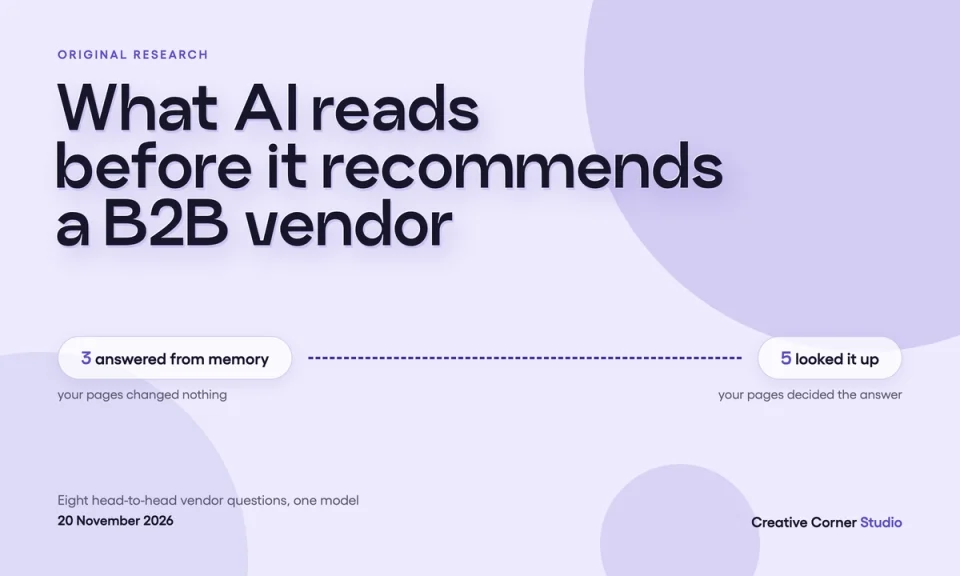
The date matters more than the figure. Citation counts move as models re-crawl, as competitors publish, and as the questions buyers ask drift. A number quoted without the day it was taken is not a measurement, and that applies to ours as much as to anyone's. Ask any agency when its figure was last checked, and how often it rechecks. The method behind ours is written up in what AI reads before it recommends a B2B vendor.
On timing: the technical work lands inside the sprint, and the first movement in citations typically follows the first full re-crawl rather than the launch date. What a programme should produce in the first quarter is a measurable change in which prompts you appear in — not a revenue line. Anyone promising the revenue line in quarter one is selling something else. The compounding happens later: once a page is the one an assistant reaches for on a question, it tends to stay that way until something better is published, which is a cheaper position to hold than a paid one.
Should you buy a tool, hire an agency, or hire in-house?
A tool measures; it does not fix. Tracking software will tell you that your brand appears in four prompts out of the set. It will not restructure your schema, write the passages that get quoted, or decide which four of those prompts were worth winning. For a team that already has someone who knows the work, a tool is the right first purchase. For a team that does not, it buys a dashboard and a feeling.
The reverse trap is more expensive. A retainer with no tracking line in it is unmeasurable by design, and twelve months of it produces a renewal conversation with nothing in it but adjectives.
Hiring in-house is the expensive option, and the reason is idle time rather than salary. AI search optimization has a heavy front half and a light tail. The audit, the schema, the entity structure and the measurement setup are concentrated into a few weeks. After that the work becomes monitoring, publishing and periodic refreshes, which does not fill a week, let alone fifty-two of them.
A salary does not pause between campaigns. We ran the arithmetic on this for ongoing Webflow work and published it: a fully loaded in-house cost of $68.36 per hour actually worked, with the working shown, in what Webflow maintenance services cost. The rate is not the problem. Paying it through the weeks when there is nothing to do is.
An agency is paid for the work, for as long as the work takes. The sprint is four to six weeks because that is how long the finite work takes, and then it stops being charged. The retainer carries the part that genuinely continues. Nobody is being paid to wait, and the two costs appear separately so you can see which is which.
The case for hiring strengthens the moment content volume rises, because content is the one line that genuinely scales with headcount. Below that threshold, a full-time hire is a fixed cost attached to a variable job.
What should you ask before you sign?
Four questions. The answers separate a priced engagement from a priced promise.
What is the build, and what is the upkeep? They are different jobs with different costs. If both sit inside one monthly figure, you cannot tell which one you are paying for, or whether either is still happening.
How many prompts, on how many platforms, against how many competitors? Measurement scope is the easiest thing to quote vaguely and the easiest to verify afterwards.
How many pieces of content a month, in writing? The largest hidden variable between two monthly figures.
What is the minimum term? A monthly rate with a six-month floor under it is a project price written sideways.
The prices on this page, $4,900 for the sprint and from $1,700 a month, are Creative Corner Studio's own. They are published on our AI search optimization page and are the prices quoted to clients. The clickthrough figures come from Advanced Web Ranking and Ahrefs, read at their sources on 27 November 2026 and attributed where they appear. No competitor's pricing is quoted anywhere on this page. The scope figures — seven phases, twenty-three steps, four to six weeks, and tracking across five AI platforms against three named competitors — describe the engagement as it is actually delivered.
Frequently asked questions
How much does AI search optimization cost for a B2B company?
AI search optimization costs $4,900 for a fixed four-to-six-week sprint and from $1,700 a month for ongoing work at Creative Corner Studio. The sprint covers the build — the audit, schema, on-page and content restructure, llms.txt and the tracking setup — and the monthly fee covers the upkeep: off-site brand signals, content, refresh cycles and reporting. Most agencies sell only a single monthly retainer with both folded inside it, which makes it impossible to see which half you are paying for in any given month.
What is included in an AI search optimization sprint?
The Creative Corner Studio sprint runs four to six weeks across seven phases and twenty-three steps, with onboarding starting within three days. It includes eight deliverables: an AI Visibility Audit across five AI platforms, a Technical SEO Audit covering crawlability, schema gaps, speed, mobile and llms.txt status, Schema Implementation of Organization, Service, FAQPage, Article and Person markup, an On-Page Restructure of titles, headings, alt text and internal linking, a Content Restructure with direct answer blocks and passage-level rewrites, a live llms.txt file, AI Visibility Tracking Setup against three named competitors, and a Monthly Report covering AI Visibility Score, prompt coverage, AI referrer sessions and competitor movement.
Is AI search optimization a one-off project or an ongoing cost?
Both, and they should be priced separately. The build is finite: schema is implemented once, the entity structure is built once, the technical layer is fixed once. The upkeep is not finite, because models re-crawl and change what they quote, competitors publish against the same questions, site changes break markup, and the questions buyers ask keep moving. When both sit inside one monthly figure you cannot tell the build from the upkeep, or whether either is still happening.
Is a tracking tool enough, or do you need an agency?
A tool measures; it does not fix. Tracking software will tell you that your brand appears in four prompts out of the set. It will not restructure your schema, write the passages that get quoted, or decide which of those prompts were worth winning. For a team that already has someone who knows the work, a tool is the right first purchase. For a team that does not, it buys a dashboard and a feeling. The reverse trap is more expensive: a retainer with no tracking line in it is unmeasurable by design.
Is it cheaper to hire someone in-house for AI search optimization?
Hiring in-house is usually the expensive option, and the reason is idle time rather than salary. AI search optimization has a heavy front half and a light tail: the audit, schema, entity structure and measurement setup are concentrated into a few weeks, after which the work becomes monitoring, publishing and periodic refreshes. Creative Corner Studio published the arithmetic for ongoing Webflow work at a fully loaded in-house cost of $68.36 per hour actually worked. The rate is not the problem; paying it through the weeks with nothing to do is. The case for hiring strengthens once content volume rises, because content is the one line that scales with headcount.
How do you measure the return on AI search optimization?
Not by traffic. Citations and traffic are decoupled: a page can be read and quoted by an assistant while sending almost no one to the site, because the answer was given inside the assistant. The number worth watching is how many of your pages an assistant is willing to quote. The date that number was taken matters as much as the number itself, because citation counts move as models re-crawl and as the questions buyers ask drift. Ask any agency when its figure was last checked, and how often it rechecks.