Webflow vs Astro and Sanity for B2B Marketing Websites
Published November 13, 2026Reading time: 18 min
The choice is not about speed or quality. It is about who can publish a page without asking anyone, and who carries the risk when something breaks. Webflow gives marketing that autonomy inside a platform. Astro and Sanity give you the codebase and content you can use anywhere else.
Creative Corner Studio builds both. We are a Webflow Premium Enterprise Partner, and we also build on Astro, Sanity and Claude — the page you are reading is on that stack. That is why we have nothing to win from this answer going either way, and why what follows is the trade-off as the documentation describes it rather than an argument for one side.
Key takeaways
The decision is about who publishes and who carries the risk, not about speed. Both answers are legitimate for a B2B marketing site.
Astro's own documentation states the architecture plainly: "Zero JS, by default" and "Server-first: Websites run faster when they render HTML on the server."
Vercel and MERJ measured 569 million GPTBot fetches in a month and found that "none of the major AI crawlers currently render JavaScript." ChatGPT fetched JavaScript files on 11.50% of requests and Claude on 23.84%, and neither executed them.
Sanity's documentation is explicit that Visual Editing is not supported in static mode, and that static sites need a rebuild to reflect content changes. The mode is set per page, not per project.
A content model can carry fields that exist to make a page answerable: a short direct answer, FAQ entries, the author, sources, internal links and structured data. None of it guarantees a citation. It makes the right thing easy to do every time.
Claude is a development assistant working on a codebase, not a CMS and not a substitute for either platform. It changes what a development task costs, which is the one thing this stack is expensive at.
You may not have to choose. Webflow Cloud supports Astro, so an Astro app can be deployed alongside a Webflow site.
Which should you choose, Webflow or Astro and Sanity?
Choose Webflow when the marketing team has to publish day to day without a developer in the loop and the site is a marketing site. That autonomy is real but it is not unconditional: someone builds the CMS Collections and the page templates first, and a page shape nobody designed is still a development task. Choose Astro and Sanity when one of three things is true. The same content has to appear somewhere other than the website, such as product documentation or an in-app help centre. The code has to sit in your own repository rather than inside a platform. Or you have hit a specific Webflow limit and can name it. Everything else in this comparison follows from those two paragraphs.
Underneath the detail, the comparison is simple to state: a finished platform against a stack you assemble. Webflow bundles the editor, the CMS and the hosting. Astro builds the front end, Sanity is the CMS, Claude is how the code gets written, and the hosting is a separate decision rather than part of the package. Everything that follows is drawn from the documentation each vendor publishes and from one measurement study. Where a claim is ours rather than theirs, it says so.
What is Webflow, and what does it do for a marketing team?
Webflow is a visual development platform that bundles the design canvas, a content management system and hosting into one subscription. A designer or developer builds the CMS Collections and the templates, a marketer then adds and edits pages inside that structure without touching code, and the platform serves them. For a B2B marketing site that ships campaign pages and blog posts, that bundle removes most of the reasons a marketing team waits on engineering.
Its limits are the limits of a hosted platform: the hosting is part of the plan rather than a choice, and server-side code is not part of the model. The CMS limits are more often misquoted than met, and Webflow is precise about them. Its documentation on dynamic content limits states that a page can hold up to 40 Collection lists and that a list displays up to 100 items by default, then adds the part most comparisons miss: "These limits control what visitors see on a page — they don't cap how many items you can store in your Content Management System (CMS), which depends on your Site plan or Platform plan." How many you can store, and how many Collections you get, is a plan question rather than a platform one. We went through where those ceilings sit in practice in Webflow CMS for enterprise teams.
What is the Astro, Sanity and Claude stack, and what does each part do?
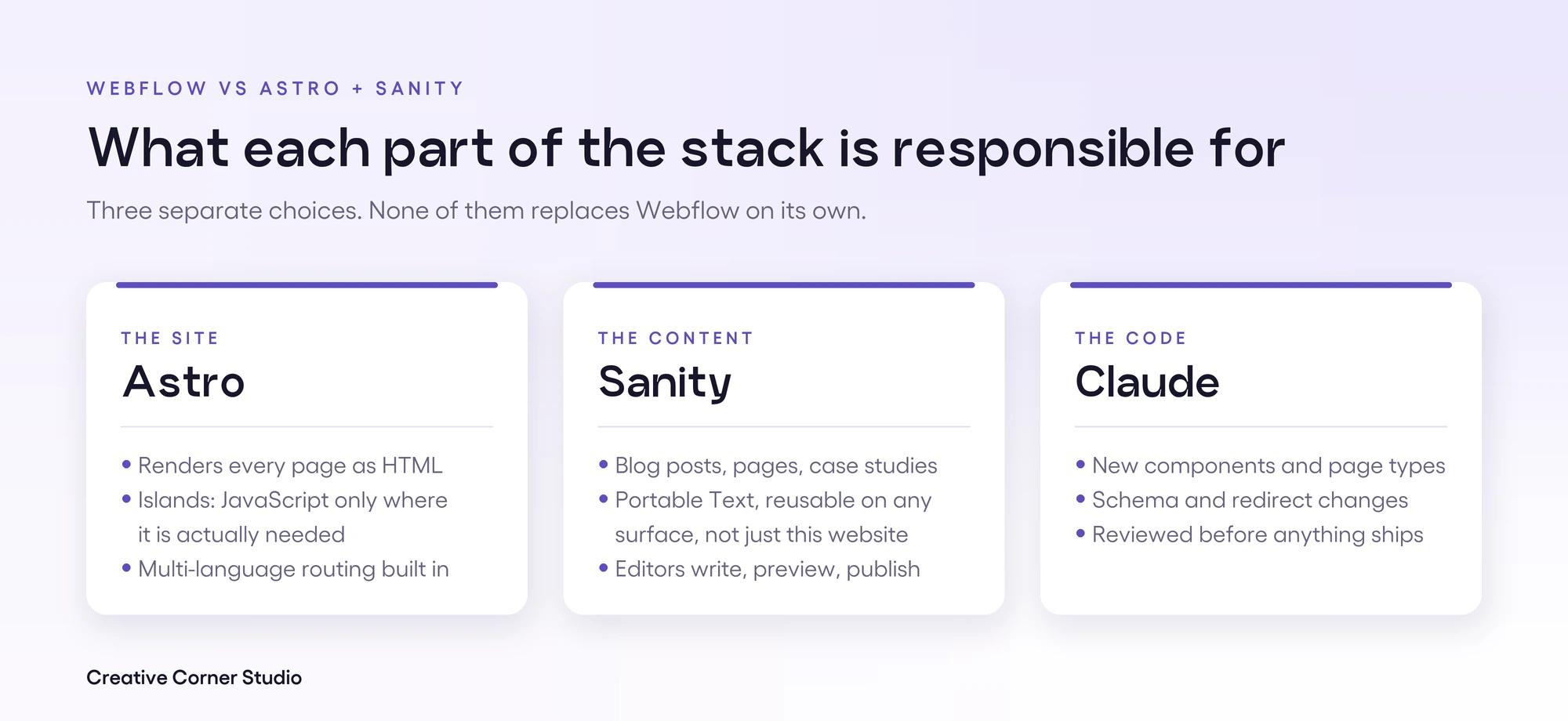
It is three separate things, chosen separately, and the division of labour is the point. Astro renders the site. Sanity holds the content and is where editors work. Claude is how the code gets written. Nothing in that list replaces Webflow on its own; together they do a different job.
This is the stack the site you are reading runs on. Creative Corner Studio moved its own marketing site and blog onto Astro and Sanity, and the pages are written and maintained with Claude Code, so everything below is described from running it rather than from evaluating it.
Astro renders the site
Astro is a web framework. It is not a platform and it is not a CMS; it builds the front end and nothing else, which is why it is always paired with something that holds the content.
Its own documentation describes it as "the web framework for building content-driven websites like blogs, marketing, and e-commerce" and lists two design principles that matter here more than any benchmark:
Zero JS, by default. "Less client-side JavaScript to slow your site down."
Server-first. "Websites run faster when they render HTML on the server."
The practical consequence is that an Astro page arrives as finished HTML. That matters for readers, and as the next section shows, it matters considerably more for the machines now reading on their behalf.
Two capabilities are worth naming, because they map onto problems B2B marketing teams actually have.
Interactivity without the page paying for it. Astro pioneered what its documentation calls islands architecture: "rendering the majority of your page to fast, static HTML with smaller islands of JavaScript added when interactivity or personalization is needed." A pricing calculator, a filterable case-study grid or a demo booker loads its own JavaScript; the rest of the page does not. The docs are explicit about what this avoids: "the monolithic JavaScript payloads that slow down the responsiveness of many other, modern JavaScript web frameworks."
Multi-market sites without a plugin. Internationalisation is built into the framework rather than bought. Locales and a default language are set in the config, and localised routing comes from /[locale]/ folders. The framework also ships fallback behaviour for pages that do not exist in a language yet, and per-language domains. For a B2B company launching the same site across several markets, that is normally the part that goes wrong, and it is the part that is usually a paid add-on elsewhere.
The cost needs stating precisely, because it is usually overstated, including by people selling the stack. Astro has no editor of its own, but the stack does: Sanity Studio is a full CMS, and editors write, review and publish in it exactly as they would in any other. A developer builds the blog post type or the templated service page once; after that the marketing team fills it in as often as it likes, with nobody waiting on anybody. That is the same arrangement as Webflow, and it is worth saying so rather than pretending otherwise.
The cost appears at one point only: when you need a page shape that does not exist yet. How often that happens is a modelling decision rather than a platform limit. A content model built from reusable blocks lets marketing assemble new pages from what already exists; a rigid model sends every new idea back to a developer. Getting that judgement right at the start is most of what separates a stack a team enjoys from one it resents.
For what it is worth, we build block-based models, so a marketing team composes new pages from blocks that already exist rather than filing a ticket for each one. The limit is honest rather than absent: a genuinely new component, one that no block covers, is still code. But "every new page needs a developer" is a description of a badly modelled project, not of the stack.
Sanity holds the content
Sanity is a headless CMS. Content is stored as structured documents and queried over an API with GROQ, rather than as pages bound to one website. Rich text is stored as Portable Text, which is data rather than markup, so the same paragraph can be rendered on a website, in an app, in an email or by something that has not been built yet.
For a B2B company this is the real argument, and it is not about the website at all. If your product documentation, your help centre and your marketing site all describe the same features, a headless CMS lets them describe it once. A site-bound CMS does not.
There is a second effect that matters more now than when headless CMSs were first sold. When an AI assistant answers a question about your product, it quotes whichever page it retrieved. If the marketing site, the documentation and the help centre each describe the same feature in slightly different words, the model has three slightly different descriptions to choose between, and you do not get to choose which one it uses. One source of truth produces one description wherever it is read. That is our reading rather than a published finding, but it follows from the mechanics set out further down: the model quotes the page it was served, not the intention behind it.
Two things make that concrete rather than theoretical.
Content that outlives the design. Sanity defines Portable Text as "a JSON based rich text specification for modern content editing platforms", and the reason it exists is that content stored this way is structured by meaning rather than by presentation. The official libraries render it to HTML, Markdown, React, Vue and plain text. In practice this is what makes a redesign cheap: the next site is a new rendering of the same content, not a re-entry of it. Anyone who has rebuilt a site by copying and pasting out of the old CMS knows what that is worth.
Launch day as one event.Content Releases "lets you organize and schedule updates across multiple documents": a product launch that touches the homepage, three solution pages, a pricing change and six blog posts is bundled, previewed as a future state, validated and published together at a set time. The honest footnote is that this is a paid feature on certain Enterprise plans, not something every Sanity project has.
The cost is that someone has to model the content before anyone can publish anything, and that model is a design decision with consequences for years.
Claude writes the code
The third element in the stack is not a platform, and saying so plainly matters more than claiming anything for it. Claude Code is a development assistant that works against a codebase. It is not a CMS, it is not hosting, and it is not a substitute for Webflow or for Sanity.
What it changes is the cost of the one thing this stack is expensive at. Adding a new page type is a development task, and that is the whole argument against the stack. It is not a licence fee, a seat count or a ceiling somebody else sets. It is development time. And development time on a codebase is the one cost in this comparison that AI coding assistants have genuinely changed. A page template is a small, well-specified job on a repository an assistant can read end to end. That is close to the best case for that kind of tooling. It does not remove the need for someone who can tell when the output is wrong, and anyone promising that is selling something. What it changes is the threshold at which a new page type is worth building at all. On a platform, that threshold is fixed by the platform. On a codebase, it is not. That is why we count it as part of the stack rather than as a tool bolted onto it. It does not remove the need for technical review and testing, and it does not make the site faster, more findable or better written. It changes what a development task costs.
How do Webflow and the Astro, Sanity and Claude stack compare?
Eight dimensions, chosen because they are what a B2B buyer is actually asked to justify. The right-hand column is the whole stack, not Astro alone.
Dimension
Webflow
Astro + Sanity + Claude
Who publishes a page
Independently, inside what exists: marketing adds and edits pages once a designer has built the Collections and templates.
Independently, inside what exists: editors add and edit pages once a developer has built the schema.
A page shape that does not exist yet
Visual: a designer builds it in the Designer, no code and no deploy.
Composed from existing blocks, if the model was built that way. A genuinely new component is code, and that is the one cost an assistant working on the repository changes.
Who owns the code
The Workspace: the site lives in Webflow and moves only by transfer.
You do: the front end is a repository you host wherever you like.
Structured content
Site-bound: CMS Collections belong to the website that renders them.
Reusable: documents are queried over an API and can feed anything.
Cost shape
Predictable: one subscription per site, priced by plan, seats and traffic.
Front-loaded and split: hosting, the CMS, tooling and development are separate lines.
What an AI crawler receives
Finished HTML: pages are served rendered.
Finished HTML, if the rendering mode is set deliberately. The choice is yours to make and yours to get wrong.
Portability
Bounded: what you can take with you is what the platform supports exporting.
Open: the source code and the content are both yours, and the host is replaceable.
Who carries the risk
The platform: uptime, security and the roadmap are Webflow's problem.
You do: hosting, dependencies and the content model are yours to run.
Nothing in that table says one column wins. The row that decides it for most B2B teams is the first one, and the row that decides it for the rest is the third.
The same comparison at a glance, across the criteria we are asked about most. These are our ratings from running both, not measurements of two specific projects.
Criterion
Webflow
Astro + Sanity + Claude
Speed of development
Fastest
Fast
Technical SEO
Strong
Strongest: every tag, URL and schema decision is yours
AEO and GEO
Strong
Strongest: answer fields and templates are part of the model
Core Web Vitals
Very good potential
Excellent potential
Design freedom
High: almost any layout, reached visually and without a deploy.
High: no platform ceiling, but every departure from the design system is written in code.
CMS
Built in
Sanity
Editing by the client
Very easy
Easy once the model is configured
Automation
Good
Very flexible
Maintenance cost
More predictable
Depends on the infrastructure you choose
Technical complexity
Low to medium
Medium to high
Control over the code
Limited
Full
What does an AI crawler actually receive?
This is the row most comparisons leave out, and it is now the row with the hardest evidence behind it. What that means for a B2B site in practice, and what to fix first, is the subject of why AI answers skip your B2B website.
In December 2024 Vercel and MERJ published an analysis of AI crawler traffic across their network. In the month they measured, GPTBot made 569 million fetches, Anthropic's crawler 370 million, AppleBot 314 million and PerplexityBot 24.4 million, against 4.5 billion for Googlebot. Their finding on rendering was unambiguous:
"none of the major AI crawlers currently render JavaScript"

ChatGPT fetched JavaScript files on 11.50% of requests
Claude fetched JavaScript files on 23.84% of requests

"they don't execute them. They can't read client-side
 rendered content."
Two qualifications, because the study is usually quoted without them. Gemini runs on Google's infrastructure and does render. AppleBot renders through a browser-based crawler. And the study is from December 2024, which is old enough that it deserves rechecking rather than repeating.
What it means for this comparison is narrow and useful. Webflow serves rendered HTML, so the question does not arise. On Astro the question does arise, and the answer is good as long as the content is in the HTML rather than assembled in the browser. Astro's islands architecture is built that way by default, which is why the framework is a sound choice here. It is also why the rendering mode is worth understanding rather than accepting.
Should the site be static or server-rendered?
Pairing Astro with Sanity creates one genuine conflict, and Sanity documents it plainly.
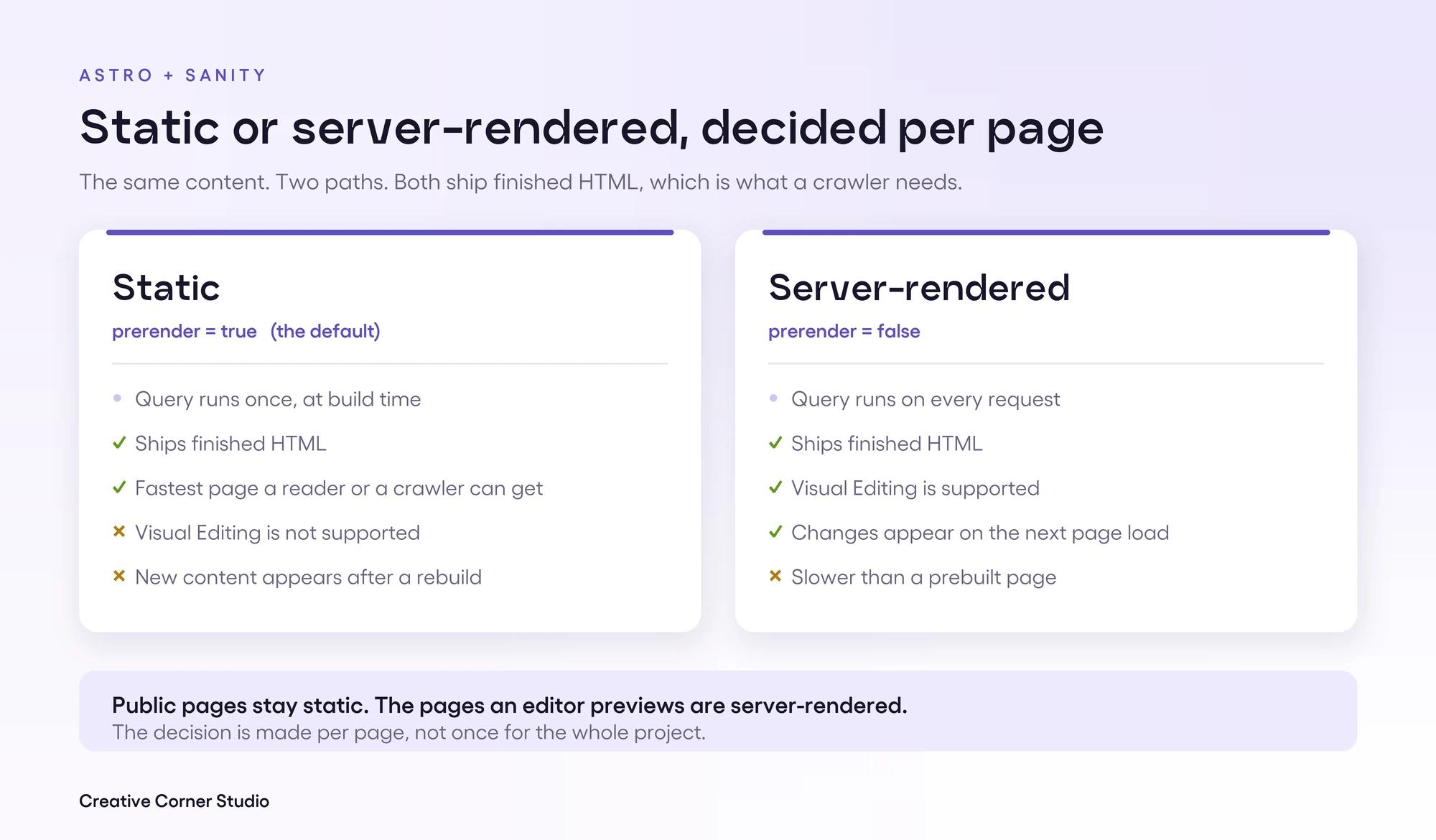
In static mode, "Every GROQ query runs once during the build." Pages are fixed until the next build, which is the fastest possible result for a reader and for a crawler. But "Visual Editing is not supported" in that mode, and "Static sites need a rebuild to reflect content changes."
In server mode, "GROQ queries run at request time, so content changes appear on the next page load without a rebuild," and Visual Editing is supported.
So the editor's live preview and the fastest possible page pull in opposite directions. The part that is usually missed is that this is not a decision for the whole project. Astro sets it per page:
// A page that opts out of static generation
export const prerender = false;

// In a server-output project, a page that opts back in
export const prerender = true;
Which means the sensible arrangement is not a compromise at all. Public pages stay static, which is what readers and crawlers want. The pages an editor needs to preview are server-rendered. The cost that remains is real and worth stating: on static pages, new content appears after a rebuild, not immediately.
What can a content model do for AI search that a page builder cannot?
This is the part we care about most, and it is the one advantage in this comparison that is specific to our work rather than to the technology.
In a site-bound CMS, a blog post is a title, a body and an image. In Sanity the document is whatever you define, so an article can carry fields that exist purely to make it answerable:
A short direct answer, stored as its own field rather than buried in the opening paragraph
FAQ entries as structured data, not as markup repeated in the body
The author and their expert biography, as a reference rather than a name typed again on every post
Sources as fields, so every claim has a traceable origin
Internal links as references between documents, which means a link map that can be queried rather than audited by hand
Structured data generated from the fields rather than hand-written per page
None of that is exotic. It is simply what becomes possible when content is data. The effect is that the editorial standards a team works to stop living in a style guide nobody opens and start living in the thing people type into. A post cannot be published without its sources if the field is required.
The necessary caveat, and we would rather say it than have a reader supply it: none of this guarantees a better ranking or a citation in ChatGPT. Content, authority, crawlability and genuine usefulness remain what decides it. We set out what an assistant actually reads before it names a supplier in how AI search is changing the B2B buyer journey. A content model makes the right thing easy to do consistently. It does not do the thing.
What does the marketing team give up?
Comparisons written by people who sell one side tend to stop before this part.
Routine publishing does not change: a post is a post, a service page is a service page, and nobody waits for a developer to put one live. What changes is the unplanned page. A designer in Webflow can invent a layout on a Tuesday afternoon and have it live by Wednesday. On the stack, that same page is either composed from blocks the model already has, or it is a ticket. Teams that shipped one-off landing pages visually feel this first. The teams that are happy a year later are the ones that modelled their content around what they actually publish, rather than around what the old site happened to look like.
The second thing to expect is the rebuild delay on static pages. A typo fix is not instant.
Neither is a reason to stay or to go. They are the price, and a decision made without them is not a decision.
Do you have to choose at all?
The comparison is usually framed as a replacement. It no longer has to be.
Webflow's developer documentation states that "Webflow Cloud supports Next.js, Astro, Vite, and no-framework static apps", and describes the Astro path as a way to "create high-performance, content-focused websites that ship minimal JavaScript by default while preserving Webflow's design capabilities."
That makes a third arrangement available: the marketing site stays in Webflow, where marketing keeps its autonomy, and the part that needs a framework is an Astro app deployed next to it. For a B2B company whose problem is one section of the site rather than the whole thing, this is often the proportionate answer.
When is each answer right?
Webflow is the right answer when the site is a marketing site, the team publishes often, and the reason to leave is a frustration rather than a constraint. Speed of publishing compounds, and a platform you can leave later is not a trap.
Astro and Sanity is the right answer in three cases. The same content has to serve more than the website. The code has to be in your repository for a reason you can state out loud. Or you have hit a limit rather than anticipated one.
Both is the right answer more often than the framing admits, now that Webflow Cloud hosts Astro.
By project type, this is what we would recommend, and why. It is our judgement from running these projects, not a benchmark.
Project
What we would recommend
Why
Small corporate site
Webflow
The build cost of a custom stack is not repaid on a site that rarely changes.
Landing page
Webflow
Campaign pages need to exist tomorrow, not next sprint.
A client who changes the design often
Webflow
Redesign stays visual work rather than becoming a deploy.
Site with a large blog
Astro and Sanity
Content volume is where a site-bound CMS starts to constrain what you can do with it.
Site with complex integrations
Astro and Sanity
Server-side code and custom endpoints sit outside the platform model.
SEO project with programmatically generated pages
Astro and Sanity
Pages built from data need the data and the template in the same place.
An SEO or content agency's own site
Astro and Sanity
If editorial discipline is the product, the content model should enforce it.
It is also the reason the honest answer to "which is better" is "for what".
Whichever direction you go, the migration is where the value is lost, not the platform. Creative Corner Studio published what six of our own redesign and migration projects actually produced in what happens to SEO during a website redesign. The mechanics of preserving a large site are in how to migrate without losing rankings. The pattern across all six was the same: the audit and the redirect map are done before design starts, or they are done badly.
Sources
Astro, Why Astro? — architecture and design principles, including "Zero JS, by default". Retrieved 13 November 2026.
Astro, Islands architecture — selective hydration and what it avoids. Retrieved 13 November 2026.
Astro, Internationalization — built-in locale routing, fallbacks and per-language domains. Retrieved 13 November 2026.
Sanity, Portable Text — definition and the formats it renders to. Retrieved 13 November 2026.
Sanity, Content Releases — bundling, scheduling and previewing a future state. Enterprise feature. Retrieved 13 November 2026.
Anthropic, Claude Code — what it is and what it works on. Retrieved 13 November 2026.
Vercel and MERJ, The rise of the AI crawler — 17 December 2024, by Giacomo Zecchini, Alice Alexandra Moore, Malte Ubl and Ryan Siddle. Retrieved 13 November 2026.
Webflow, Webflow Cloud — supported frameworks and deployment model. Retrieved 13 November 2026.
Webflow, Dynamic content limits — Collection list and display limits, and the distinction from storage limits. Retrieved 13 November 2026.
Webflow, Plans and pricing — what each Site plan includes. Retrieved 13 November 2026.
Frequently asked questions
Is Webflow or Astro and Sanity better for a B2B marketing website?
Neither is better in general. It depends on the size of the company and on what the website has to do. Webflow suits a small or mid-sized marketing team with no developer of its own, where the site is the company's main published surface and the people who edit it are the people who designed it. Astro and Sanity suit a company that already has engineers, or whose content has to serve the website plus a product, an app or a documentation site at the same time. In both, a developer or designer builds the page type once and marketing then publishes into it without help. The difference appears only when a page shape does not exist yet: in Webflow a designer builds it visually, and on Astro and Sanity it is written in code unless the content model was built from reusable blocks. The decision follows the problem, not the platform. If the problem is that the same information has to read the same way everywhere, and that the team wants to build its own pages without waiting for anyone, the stack is the right answer: a developer builds the blocks once, which is the part Claude Code shortens, and after that marketing assembles pages from them in Sanity. If the problem is that the editor feels slow or the subscription costs more than expected, Astro and Sanity will not fix it. You still pay for a CMS plan and for hosting.
What is Astro, and why is it used for marketing websites?
Astro is a web framework for the front end only; it holds no content and is always paired with a CMS. Its documentation describes it as "the web framework for building content-driven websites like blogs, marketing, and e-commerce" and names two principles that explain the fit: "Zero JS, by default" and "Server-first: Websites run faster when they render HTML on the server." The practical result is that a page arrives as finished HTML rather than being assembled in the browser. That is the part that matters for search and for AI search. A crawler that does not run JavaScript sees the whole page, because there is nothing left to assemble, and the page is complete on the first response rather than after a second round of requests.
What is Sanity, and what does a B2B company gain from it?
Sanity is a headless CMS. Content is stored as structured documents and queried over an API with GROQ, and rich text is stored as Portable Text, which is data rather than markup. The gain for a B2B company is not about the website: it is that the same description of a feature can serve the marketing site, the documentation and the help centre without being written three times. The cost is that the content model has to be designed before anyone can publish. There is a second gain that is easy to miss. A content model can be built from reusable blocks, so a page is assembled from components an editor picks and fills rather than from a layout a developer writes each time. Once the blocks exist, the marketing team builds its own pages.
Do AI crawlers read JavaScript, and does it change the Webflow or Astro choice?
Mostly they do not. Vercel and MERJ analysed AI crawler traffic across their network in December 2024 and reported that "none of the major AI crawlers currently render JavaScript". ChatGPT fetched JavaScript files on 11.50% of requests and Claude on 23.84%, and neither executed them. Gemini and AppleBot are the exceptions and do render. For this comparison the effect is narrow: Webflow serves rendered HTML, and Astro does too by default, so both are safe as long as content is not assembled in the browser.
Can you use Astro and Webflow together instead of choosing?
Yes. Webflow's developer documentation states that "Webflow Cloud supports Next.js, Astro, Vite, and no-framework static apps", and describes the Astro path as a way to create content-focused sites that ship minimal JavaScript "while preserving Webflow's design capabilities". For a company whose constraint affects one part of the site rather than all of it, this is often the proportionate answer.
Does using Claude mean the project needs fewer developers?
No, and anyone saying otherwise is selling something. Claude Code is a development assistant that works against a codebase; per Anthropic's own documentation it writes and edits code, which still has to be reviewed and tested by someone who can tell when the output is wrong. What it changes is the cost of the one thing this stack is expensive at: adding a new page type is a development task, and a page template is a small, well-specified job on a repository an assistant can read end to end. It lowers the threshold at which a new page type is worth building. It does not remove the people.
Does a headless CMS help you get cited by AI assistants?
Not by itself. Content, authority, crawlability and genuine usefulness are what decide whether a model quotes you, and no CMS supplies those. What a content model changes is consistency: fields for a short direct answer, FAQ entries, the author, sources, internal links and structured data mean every page carries them, because the model requires them rather than a style guide suggesting them. There is a second effect worth knowing. A model quotes the page it retrieved, so if your marketing site, documentation and help centre describe the same feature in different words, you do not control which description it uses. That cuts both ways, and it is the argument for a single source of truth. A model tends to repeat what it finds stated the same way in more than one place, because agreement across sources is what it has instead of a way to check a fact. When one content model feeds the site, the documentation and the help centre, the number, the definition and the product name come out identical everywhere, so the repetition is real rather than three people happening to agree. None of this guarantees a citation. It removes the contradictions that cost you one.